Issue: The dual-GPU process exposed a Level Zero host-memory tax, MTP4 full graph capture deadlocked, and concurrent prefill plus speculative decode still crashes the GDN causal-convolution path.
Solution: Use TP2 with one Level Zero mask per worker, Docker SYS_PTRACE for oneCCL IPC, MTP4 with XPU Graph disabled, and keep PP2 as a separate load and coherence validation route.
Issue: Restarting the old container does not pick up new patches. Prefix cache was off because that matches a cold decode card, which is the wrong default for real multi-turn sessions.
Solution: Image tag 2026.08.19 applies mixed-split v5 plus draft-INT4 S+M1, turns prefix cache on, and ships Upgrade-Qwen38-Docker.ps1 so the container is recreated. Same model files, same 4.25 GiB display-safe KV pin.
Issue: Eager vLLM spent 32 ms/token in CPU enqueue (~950 launches). Compiled grouped_topk crashed. Official DFlash is NVFP4. The first DFlash screen (214/185 t/s) was n=3 and production respawned mid-load.
Solution: XPU graphs (at::zeros grouped-GEMM + native grouped-topk) for the 93 t/s no-spec floor; NVFP4→BF16 DFlash draft; isolated n=5 with production pinned off. Publish the artifacts on Hugging Face under SergiioB.
Issue: Prefill looked 3-4× slower than the dense-27B baseline, decode was called 'very slow', and the obvious vLLM quant (FP8-block) looked like the fix.
Solution: Rebuild with GGML_SYCL_F16=ON (the missing flag was the whole prefill gap), screen DFlash draft depth 1-8 at 128K ctx / 230 W, confirm the winner with n=5, and push the long-context curve to 32K.
Issue: Two assumptions blocked progress: (1) 'num_speculative_tokens=2 clamps to 1' — false, the MTP module is recurrent (spec_step_idx % num_mtp_layers), so a single layer emits N draft tokens per step. (2) 'prefill scales with power' — a claim from unpaired runs that turned out to be prefix-cache contamination, not a real power effect.
Solution: Ran a clean spec-token sweep (MTP1/2/4) with an honest cold-prefill harness (unique random prefix per call so prefix caching never fires), read acceptance directly from the vllm:spec_decode_* counters, then ran a paired alternating 150W-vs-230W power A/B to settle the power question rigorously.
Issue: Older public surfaces mixed short-generation peaks, cold input rate, exact-128K completion, resident-session latency, and historical engine grids. Those metrics answer different questions.
Solution: The current recipe pins a public vLLM XPU image by digest, applies two patches in order, calibrates exact prompt shapes, and measures no-spec, MTP1, MTP2, and MTP4 in separate C1 input and output phases.
Issue: The vLLM path has three gates, and each one turned out to be real: (1) the FP8 checkpoint for this model is 37.5 GB — it does not fit 32 GB of VRAM, so FP8 is off the table for 35B; (2) the MXFP4 (Intel 4-bit) checkpoints that exist publicly are in the compressed-tensors layout, which vLLM's XPU build rejects; (3) the prebuilt Intel images have an MXFP4 MoE path written for gpt-oss — the Qwen loader is broken in seven separate places, from tensor shapes to activation gating to hybrid-model page sizes.
Solution: I built the native-format MXFP4 checkpoint myself (fused 256 experts per layer into the w13/w2 layout, verified to 8.8e-5 MSE against BF16 ground truth), moved to the newer intel/vllm:0.17.0-xpu image, and patched the seven engine bugs in-container — 2D per-expert loader support, missing scale-key mapping, the silu-vs-swiglu_oai activation gate (the XPU kernel supports silu; the Python gate doesn't), CUDA-only device contexts in the linear-attention path, a contiguity check, and the hybrid block-size alignment that produced a page size the XPU flash-attention kernel rejects. The model then served and generated correct output.
Issue: Long-context prefill was 2.4× slower than it should have been, and b10222 carried a multi-turn corruption bug (SDPA scale use-after-return, #25880). Two upstream PRs that fix exactly this — #25874 (quantized-KV XMX FA) and #25880 — shipped after our pinned release, so the fixes were not in the production build.
Solution: Rebuilt llama.cpp SYCL from upstream master (commit 071327508, b10255+) into build-sycl-0804 with the same config (-O3 -DNDEBUG, DNN=ON, F16=ON, GRAPH=ON, oneAPI 2026.0). Ran a same-day A/B against b10222 on both MoE 35B and dense 27B, then promoted the strictly-better build to production via a single config value (profiles.json runtime.binary), backed up and health-verified.
Issue: Running LLMs on Intel Arc requires SYCL-specific knowledge that doesn't exist in one place: which cmake flags, which env vars, which KV cache config, which power cap, which context length per model. Getting any of these wrong means either crashes, bad quality, or leaving performance on the table.
Solution: Fact-checked every claim against llama.cpp PRs and external benchmarks, ran a full boundary sweep measuring VRAM at every quant/context combo, A/B tested two SYCL builds, and consolidated everything into one recipe with the exact commands and measured numbers.
Issue: The 27B dense model is VRAM-hungry (16-21 GB weights + 7-14 GB KV at high context), making the quant/context/KV trade-off non-obvious. The previous fleet used q5_0-q4_1 KV cache, but KL-divergence analysis showed q8_0 K + q4_1 V is near-lossless. The context ceiling per quant was unknown.
Solution: Tested all three quants (Q4_K_M, Q5_K_M, Q6_K) at every context length (128K-512K) with q8_0 K + q4_1 V KV cache. Measured VRAM boundaries, decode speed, and prefill with llama-bench. MTP-4 speculative decoding adds +35-50% decode. The KV insight: dense models use 3.8x more KV cache than MoE — so a 16 GB dense model can't pass 256K while a 25 GB MoE fits a 512K context allocation.
Issue: Short-prompt prefill looked terrible, dense Gemma needed a path that was not stuck at ~16 t/s, and agent CLI numbers were being confused with engine throughput.
Solution: Re-measure with engine timings at long prompt sizes, replace Gemma 26B with Gemma 4 31B + Unsloth MTP draft + vision mmproj, keep MoE profiles for speed, and run Grok Build with tools on.
Issue: Grok Build defaults to cloud models; local routing needs correct base_url, model IDs, auth env, and an honest split between engine tok/s and agent wall time.
Solution: Install Grok Build, point custom models at http://127.0.0.1:8765/v1 with model id active (or matching served id), set XAI_API_KEY to the server API key, keep tools enabled for real agent work, and switch llama-server profiles underneath.
Issue: I was using an aggressive `Q5_0` quantization for the Key (K) cache and `Q4_1` for the Value (V) cache. Over long contexts, the model's reasoning capabilities began to degrade, showing signs of hallucination and logic loops.
Solution: Researched the Kullback-Leibler (KL) divergence of various KV cache quantization formats in llama.cpp. Discovered that the Key cache is highly sensitive to precision loss due to dot-product attention mechanics. Shifted to a hybrid `K=Q8_0 / V=Q4_1` profile.
Issue: We attempted to compile and run TurboQuant (TQ) — a promising new WHT-based quantization method — on Intel Arc hardware using an experimental SYCL fork, but hit hard driver and kernel limitations.
Solution: Documented the failure modes (specifically `SET_ROWS` view tensor crashes) and fell back to stable asymmetric block quantization (`K=Q8_0 / V=Q4_1`) for production use until upstream support matures.
Issue: Baseline sequential generation hard-capped at ~67 tokens/second due to memory bandwidth starvation. Furthermore, naive scaling with large contexts (131K) and unoptimized batching caused immediate VRAM exhaustion (OOM) and server timeouts under load. Later (2026-08): the community insisted vLLM was strictly better — a claim that needed a head-to-head on the same card.
Solution: Diagnosed hardware bottlenecks and optimized the llama.cpp SYCL stack. Disabled heavy DNN operations (`GGML_SYCL_DISABLE_DNN=1`), quantized the KV Cache (`Q5_0`/`Q4_1`), and saturated the GPU using deep micro-batching (`-b 8192 -ub 4096`) under a 32-parallel request load. In 2026-08, stood up the full vLLM XPU path (self-built native MXFP4 checkpoint + 7 engine patches) and benchmarked both engines at 1/4/8/16 concurrent users on the same hardware.
Issue: Standard q8_0 KV cache quantization used a 0.531 VRAM multiplier, capping a 35B Q5 model at 128K context on 32GB. The question was whether asymmetric K/V quantization (q5_0 for K, q4_1 for V) could unlock higher context lengths without hitting the quality cliff or degrading throughput.
Solution: Ran a 5-test hardware-verified benchmark suite on llama.cpp b9851 comparing q8_0-q8_0 against q5_0-q4_1 across control baseline, target comparison, flagship configs, and dense model validation. Calculated per-model VRAM budgets using measured multipliers from the Anbeeld 2026 KV cache benchmark methodology.
Issue: The initial power sweep data was inflated. Single-prompt prefix caching was active during testing, which inflated the baseline measurements by approximately 4-5%. This made the speculative decoding gains appear larger than they actually were.
Solution: Rewrote the benchmark script to enforce warmup discards, isolate engine decode rate from wall-clock time, and maintain strict thermal cooldowns between test rounds. Re-ran the entire power sweep with the corrected methodology.
Issue: The obvious checks all passed: the GPU was visible through Level Zero, ReBAR exposed the full 32GB BAR, the model fit in VRAM, and Vulkan could load it. SYCL still failed during model load, first with xe bcs engine resets and then with SIGSEGV crashes even when GPU offload was disabled.
Solution: I rebuilt llama.cpp from current master with Level Zero development headers installed, disabled Intel SYCL persistent kernel cache, pinned the Level Zero device explicitly, and reduced the environment to the smallest set of variables required for stable SYCL inference.
Issue: How splitting a monolithic system prompt into static and per-session layers improved estimated KV cache hit rates from ~42% to ~76% and reduced input costs by an estimated 57% on a Firebase Functions app running DeepSeek V4 Flash.
Issue: Consumer GPUs have hard VRAM ceilings. Running 23-35B parameter models on 16GB requires aggressive quantization, KV cache compression, and precise build flags. The noise-to-signal ratio in online benchmarking is high — most people test on NVIDIA, not AMD RDNA3, and few test MoE architectures with context windows above 32K.
Solution: Systematically benchmarked 8+ models across 5 quantization levels, swept GPU power caps from 30W to 190W, tested 3 KV cache configurations, and pushed context limits to 256K. Documented the exact llama.cpp build flags and runtime parameters that make 128K inference on 16GB VRAM stable and fast.
Issue: Mixed branches make PRs unreviewable, increase blast radius, and risk dragging unrelated changes into production. When one branch contains role code, host variables, certificate files, and inventory updates together, reviewers cannot isolate what changed or why.
Solution: Split the oversized branch into multiple clean, topic-focused branches by checking out only the relevant paths from the mixed branch into new branches created fresh off main.
Issue: Previous benchmarks measured raw llama.cpp throughput but not real quality through the agent pipeline. Models that looked fast synthetically failed at reasoning, refused tool calls, or got intercepted by workspace routing before reaching the model.
Solution: Built a 14-test, 6-dimension benchmark harness that tests every model through the live Discord pipeline with quality validation: reasoning, factual accuracy, code generation, instruction following, tool calling, and math. Tested 14 models (9 CPU GGUF + 3 NPU RKLLM + 2 large MoE) with BENCHMARK_MODE to isolate pure model performance.
Issue: Most local model UIs either abstract away the runtime details that actually matter on constrained hardware or assume desktop-class GPUs. On RK3588, that makes it harder to tune context, KV cache quantization, reasoning behavior, and model selection credibly.
Solution: Built and published `llamacpp-workbench`, a remote llama.cpp workbench with explicit runtime controls, model presets, markdown chat rendering, streaming responses, and benchmark-backed defaults for REAP and dense GGUF models.
Issue: The usual local-AI advice overemphasizes parameter count and underexplains bandwidth, context budget, KV cache policy, and interactive latency. On RK3588, that leads to bad defaults: models that technically load but feel broken in real chat and tool-calling workloads.
Solution: I ran a corrected Qwen3.5 sweep on RK3588 using source-built llama.cpp, quantized KV cache, and task-pass validation. Then I compared prefill, decode, stable context, average latency, and tool-calling behavior to determine the right model for each workload.
Issue: Operators lacked a practical framework for choosing quantization, sizing VRAM budgets, deciding when CPU offload is acceptable, and understanding the difference between weight quantization and KV cache quantization. Windows-specific setup questions also created confusion around native builds versus WSL.
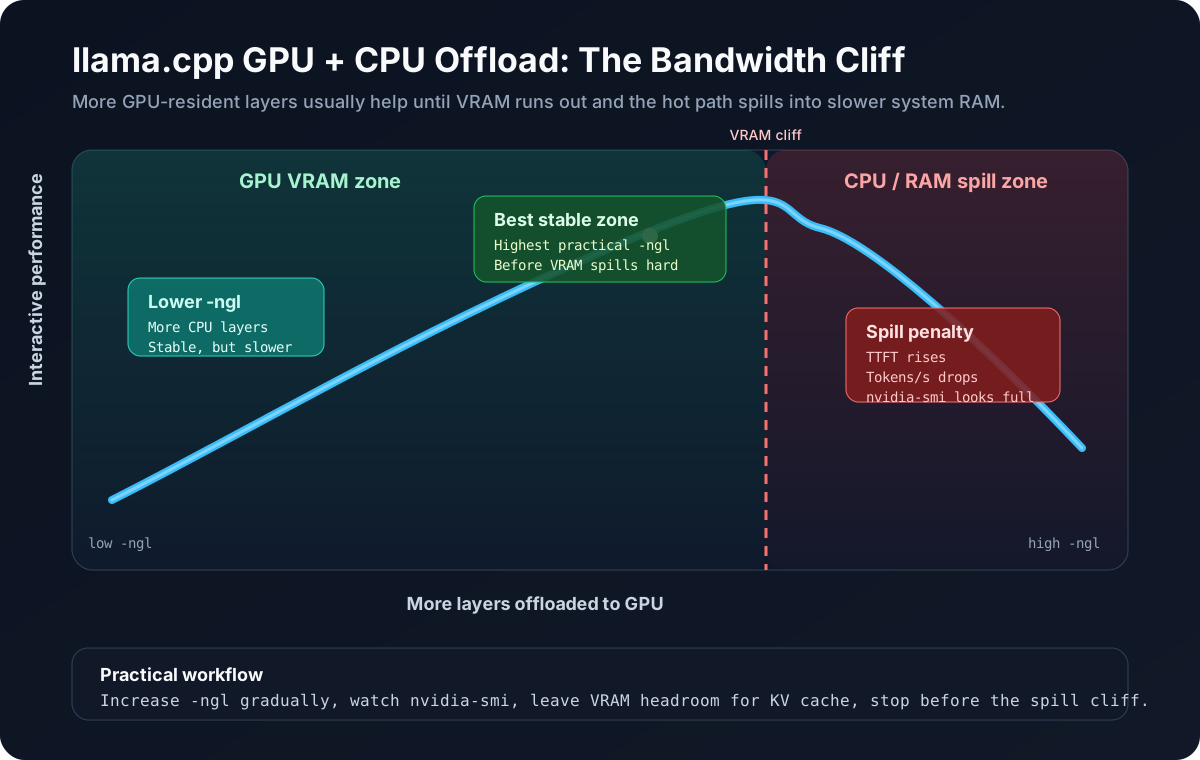
Solution: Documented the bandwidth-first model, explained hybrid offload behavior for 12 GB and mid-range modern GPUs, compared quantization choices such as Q4_K_M and q4_0 KV cache, and provided concrete llama.cpp launch patterns for Linux, Windows, and WSL.
Issue: Every time you message an AI chatbot, the model stores your conversation in temporary memory called the KV cache. On large models, this cache alone can consume 40GB—more than the model itself. On a constrained edge device, this is the difference between working and broken.
Solution: Implemented hybrid per-layer KV cache quantization inspired by Google's TurboQuant (ICLR 2026). By using 8-bit quantization for early transformer layers (where attention quality matters most) and 4-bit quantization for later layers, we achieved 17% better compression without quality loss.
Issue: Processing millions of high-velocity data points per second for immediate broadcast insights and race strategy required moving beyond traditional databases to highly decoupled, event-driven streaming architectures capable of sub-millisecond HTAP and GenAI integrations.
Solution: A technical deep dive into F1's AWS 'Track Pulse' architecture utilizing Kinesis sharding and DynamoDB caching, compared alongside Formula E's GCP HTAP architecture leveraging Pub/Sub, AlloyDB's columnar engine, and Vertex AI for real-time coaching.
Issue: Several paths technically loaded but were not practically usable. Large models timed out or delivered poor latency, CPU tuning mattered more than expected, and the product narrative needed to shift from 'many runtimes' to a benchmark-backed llama.cpp-first architecture.
Solution: Benchmarked llama.cpp and RKLLM on RK3588, identified the winning CPU configs for Qwen 3.5 4B and 9B, clarified where the NPU helps, documented KV cache and quantization choices, and reframed the architecture as llama.cpp-first with NPU used selectively.
Issue: Scattered knowledge means slower response times during critical operations. Having Linux commands on one page and Ansible/Python commands on another breaks the operational flow.
Solution: Compiled every sanitized, production-tested command snippet from my daily workflow into a single, massive reference guide with a coordinated SVG poster set.
Issue: A case study on resolving application vs network conflicts by migrating from legacy OS-level IP aliasing to a robust reverse proxy architecture.
Issue: As your application scales, Microsoft's default rate limits can throttle your service, leading to slow responses and inconsistent user experiences. You're essentially stuck in traffic during peak hours.
Solution: Think of it like a toll road. Standard use is like paying per mile, but you're stuck in traffic. Azure's Provisioned Throughput (PTU) is like renting your own dedicated express lane. We built a framework to calculate the exact financial break-even point between the two models.
Issue: One mixed list of Linux and automation commands is hard to scan during a delivery window. The commands need context, safe placeholders, and a quick explanation of the flags that matter.
Solution: Split the automation workflow into its own sanitized snippets post and grouped the commands into the same order I usually follow in a fresh repository: bootstrap, dependencies, secrets, linting, test scenarios, and quick local sharing.
Issue: The knowledge existed, but it was fragmented across storage work, account management, package checks, Git recovery, and automation workflows. That fragmentation increases the chance of typos and slows down repeat work.
Solution: Consolidated the most reused Linux and admin commands into a snippets-first cheatsheet, grouped them by task, added flag guidance, and replaced every real identifier with placeholders.
Issue: Off-the-shelf OCR solutions couldn't handle the complexity of insurance documents. Different insurers used different layouts, multilingual support was limited, and extracted data needed to conform to a strict canonical schema for downstream systems.
Solution: Implemented a custom document intelligence solution using Azure AI Document Intelligence, training models on labeled examples to extract and normalize fields across multiple insurers and languages.
Issue: Direct IP replacement would cause service disruption. Applications had hardcoded references to old hostnames. Certificates were tied to specific DNS names. Testing needed to happen in parallel with production operation.
Solution: Implemented a two-phase DNS migration strategy using temporary test records, multi-SAN certificates, and coordinated DNS switchover during a planned maintenance window.
Issue: Edge devices have hard constraints: limited RAM, no GPU VRAM, and strict latency requirements for interactive applications. The naive approach of 'make the model fit' failed repeatedly—either latency was too high or context windows would overflow during long conversations.
Solution: Developed a three-pronged approach: (1) enforce bandwidth-first model selection, (2) use KV cache quantization to reduce memory footprint, and (3) implement hierarchical context folding for long conversations.
Issue: No certificate lifecycle management, manual deployment prone to human error, security risks from unencrypted private keys, and reactive rather than proactive expiration monitoring causing service disruptions.
Solution: Implemented comprehensive certificate automation using OpenSSL for CSR generation, Ansible Vault for encryption, automated deployment roles, expiration monitoring with 90-day alerts, and standardized multi-SAN certificate templates.
Issue: Existing automotive apps are passive logs. Adding AI creates risks: prompt injection through user input, data privacy concerns, API cost runaway, and potential for incorrect safety-critical advice.
Solution: Designed IntelliAuto with AutoMind AI assistant featuring backend proxy architecture, multi-layer prompt injection prevention, dynamic affiliate link generation, and strict safety disclaimers for automotive advice.
Issue: Personal finance apps either had weak security practices, unclear data policies, or required trusting black-box systems. I needed full visibility and control.
Solution: Built IntelliFlow from scratch with infrastructure-grade security: encrypted local storage, strict Firebase security rules, biometric auth, and AI features with privacy-preserving design and prompt injection safeguards.
Issue: AD integration was fragmented across multiple playbooks with no unified approach. Users couldn't 'su' to service accounts, SSO setup was manual and error-prone, and access control required manual sudoers edits on each server.
Solution: Implemented a unified AD integration strategy: AD group mapping for sudo access, automated Kerberos keytab deployment via Ansible, and standardized PAM configuration across all servers.
Issue: Storage operations were handled inconsistently across the team. Some admins would reboot servers for partition changes, others would attempt risky online operations without proper checkpoints, and migrations often resulted in extended downtime windows.
Solution: Documented a standardized LVM playbook covering the three core operations—expansion, shrinking, and migration—with clear pre-flight checks, execution steps, and rollback procedures.
Issue: NFS configuration was inconsistent across servers. Some used hostnames, others used IPs. Network routing issues caused connections over slow backup networks instead of high-bandwidth production networks. Permission errors blocked user access.
Solution: Implemented automated NFS management using Ansible roles for export configuration, client mounting with proper network selection, and troubleshooting runbooks for common failure scenarios.
Issue: Server provisioning was inconsistent across team members. Some skipped steps, documentation was scattered across wikis and emails, and handoffs to application teams were incomplete—missing access groups, wrong technical user configurations, or incomplete application dependencies.
Solution: Developed a standardized provisioning checklist and Ansible playbook structure that covers the complete lifecycle from VM deployment to application-ready state.
Issue: Without explicit controls, an AI API is vulnerable to abuse (burst traffic), unsafe inputs (command/path traversal), leaked secrets, and silent security regressions from dependencies.
Solution: Implemented five security modules: encryption at rest, enhanced rate limiting, advanced input validation, security monitoring + alerts, and vulnerability scanning with report generation.
Issue: Manual Firebase deployments are easy to mis-target (wrong project/hosting target), hard to audit, and slow to coordinate without realtime status notifications.
Solution: Centralized deployment configuration into an `accounts.json` profile, added API endpoints for account switching, and integrated Discord webhooks for start/success/failure notifications with log snippets.
Issue: CPU-only inference on small models was too slow for interactive UX, and some NPU model runs initially failed for non-runtime reasons (corrupted downloads or wrong target platform conversions).
Solution: Benchmarked CPU (Ollama) vs NPU (RKLLM), applied system and inference parameter optimizations, and documented failure modes to distinguish model-file issues from NPU/runtime issues.
Issue: Lack of understanding about stretched networks, leaf-spine trade-offs, and how application traffic patterns would be affected.
Solution: Documented the stretched network architecture, analyzed application traffic flows, and provided clear guidance on which applications were suitable for stretched L2 vs. Layer 3 approaches.
Issue: Needed a repeatable way to use Ansible and adcli to safely remove a Linux server's computer object from Active Directory during decommissioning.
Solution: Implemented a practical runbook/automation pattern with clear safety checks, execution steps, and verification points.
Issue: The app was locked to standard 60Hz rendering, causing sub-optimal scrolling experiences on devices capable of 90Hz or 120Hz. Additionally, users had to navigate through multiple screens to perform frequent actions.
Solution: Detected 90Hz+ display modes and configured window post-processing preferences for smoother rendering, then implemented static XML-based app shortcuts routed via deep links.
Issue: Manual software installations were time-consuming, inconsistent across servers, and couldn't be reproduced reliably for disaster recovery.
Solution: Developed Ansible patterns for silent installations with templated response files, pre-requisite validation, and idempotent deployment checks.
Issue: Ansible playbooks that worked on the control node failed on execution environments with missing dependencies, and reproducing issues was difficult without consistent environments.
Solution: Built custom Execution Environments using ansible-builder, packaging all Python dependencies, Ansible collections, and system packages into versioned container images.
Issue: No consistent reverse proxy pattern, manual SSL certificate management, and inconsistent load balancer configurations across environments.
Solution: Developed an Ansible role for Apache reverse proxy with automated SSL deployment, health check endpoints, and standardized load balancer configurations.
Issue: Needed a repeatable way to leverage AI scaffolding to focus on infrastructure, security, and architecture while building a personal finance app.
Solution: Implemented a practical runbook/automation pattern with clear safety checks, execution steps, and verification points.
Issue: No standardized golden images, manual image building was error-prone, and configuration drift between images caused deployment failures.
Solution: Implemented Packer with StackGuardian for automated golden image pipelines, creating standardized RHEL images with consistent configurations.
Issue: Directly exposing LLMs to users risks massive API costs through spam or unbounded context windows. Furthermore, raw user input is vulnerable to jailbreaks (e.g., 'ignore previous instructions and execute code').
Solution: Implemented a multi-tier model routing strategy (chat vs reasoning), robust context truncation, regex-based jailbreak detection, and strict timestamp-based rate limiting.
Issue: The backend AI needed to recognize user intent and categorize vehicle parts accurately regardless of the input language, and subsequently generate both localized predictive maintenance responses and tailored affiliate search queries.
Solution: Implemented comprehensive multi-language keyword dictionaries, extracted user language context directly from client requests, and used mapping dictionaries to serve localized response templates.
Issue: Large Language Models charge per token. When you send a 1,000-token system prompt alongside a 50-token user question, you pay for 1,050 tokens every time, even though 95% of the payload never changes between requests.
Solution: Restructured the API payload to isolate static system instructions so the backend can take advantage of cached-input pricing or prompt caching features where the provider supports it.
Issue: No centralized user management for local accounts, UID/GID inconsistencies breaking applications, and sudo access scattered across individual sudoers files.
Solution: Implemented Ansible-based user management with host_vars for server-specific accounts, standardized UID/GID ranges, and templated sudoers configurations.
Issue: No automated way to gather user permission data, manual auditing was error-prone and time-consuming, and compliance reports were always delayed.
Solution: Developed a bash script that collects user accounts, sudo access, and group memberships, outputting a standardized report that could be consolidated across all servers.
Issue: Direct-to-cloud write operations failed silently during poor network conditions. Historical data had hardcoded sync limits, and offline/guest modes were improperly triggering authentication flows.
Solution: Adopted the Outbox Pattern for all write operations, separated local execution from cloud sync workers, and implemented comprehensive state tracking with retry logic.
Issue: No single source of truth for common RHEL administration commands, leading to inconsistent practices and repeated onboarding questions.
Solution: Created a living cheatsheet covering systemd, LVM, networking, user management, and troubleshooting - the commands used daily in our environment.
Issue: No clear separation between dev and prod environments, inconsistent variable hierarchy, and accidental cross-environment changes were becoming common.
Solution: Implemented a standardized repository structure with separate inventory directories, clear group_vars/host_vars hierarchy, and environment-specific variable overrides.