Chapter 3 LLM Handbook Part 3: DeepSeek-V4, GQA & Lookahead Sparse Attention
How DeepSeek-V4 uses Grouped Query Attention and Neural Memory Indexers to achieve 500K context windows with a 90% VRAM reduction.
DeepSeek-V4: Architecting for Ultra-Long Contexts
The release of DeepSeek-V4 marks a significant architectural shift in managing the memory walls associated with massive context windows. At a foundational level, DeepSeek-V4 utilizes 80 transformer layers (excluding its single Multi-Token Prediction or MTP layer). But its most critical innovations lie in how it handles the Key-Value (KV) cache bottleneck during inference.
By combining Grouped Query Attention (GQA) with a novel mechanism known as Lookahead Sparse Attention (LSA) via FlashMemory, DeepSeek-V4 achieves a staggering 500K token context window while reducing VRAM overhead by 90%.
Grouped Query Attention (GQA) vs. Multi-Head Attention (MHA)
Traditional Multi-Head Attention (MHA) allocates a unique Key (K) and Value (V) head for every Query (Q) head. While this maximizes expressivity, the memory bandwidth required to load the KV cache during the decoding phase scales linearly with both batch size and sequence length.
Mathematically, in MHA with H heads, the attention output for head i is:
Attention(Q_i, K_i, V_i) = softmax((Q_i · K_i^T) / sqrt(d_k)) · V_iFor H query heads, you must cache H key and value matrices.
Grouped Query Attention (GQA) interpolates between MHA and Multi-Query Attention (MQA). Instead of a 1:1 mapping (MHA) or an H:1 mapping (MQA), GQA divides the H query heads into G groups, where each group shares a single KV head.
DeepSeek-V4’s specific GQA implementation:
- Query Heads (
H): 64 - KV Heads (
G): 8 - Head Dimension (
d_k): 128
This configuration means that every 8 query heads share a single KV head. This drastically reduces the size of the KV cache by a factor of 8 compared to standard MHA, alleviating the memory bandwidth bottleneck during the auto-regressive decoding phase while maintaining near-MHA quality.
The VRAM Crisis at 500K Context
Even with the 8x KV cache reduction provided by GQA, a 500K context window still poses an existential threat to VRAM. In standard decoding architectures, the entire context’s KV cache must be resident in High Bandwidth Memory (HBM) to compute attention for the next token. At half-precision (FP16/BF16), scaling to 500K tokens across large batch sizes rapidly exceeds the VRAM capacity of even clustered 80GB GPUs.
FlashMemory: Lookahead Sparse Attention (LSA)
DeepSeek-V4 addresses this bottleneck through FlashMemory, an implementation of Lookahead Sparse Attention (LSA) detailed in their recent paper [arXiv:2606.09079].
Instead of passively loading the full 500K token KV cache into VRAM, FlashMemory actively predicts which historical tokens will be relevant for upcoming generations and fetches only those chunks.
The Neural Memory Indexer
The core of LSA is the Neural Memory Indexer, implemented as a Dual-Encoder system:
- Encoding History: The context is divided into chunks. The indexer encodes these chunks into highly compressed representations stored in a secondary memory tier (e.g., host RAM or NVMe).
- Lookahead Prediction: As generation proceeds, the current query state is continuously evaluated against the indexed chunks.
- Sparse Fetching: Every 64 tokens, the indexer evaluates the query projection to predict the most critical KV chunks for the next block of tokens. Only these high-value chunks are asynchronously prefetched into VRAM.
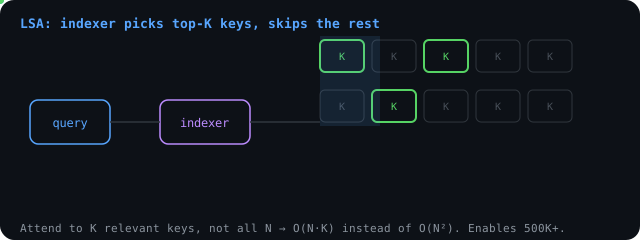
By fetching only the critical subset of keys and values, the attention mechanism becomes sparse. DeepSeek-V4’s LSA reduces the active KV cache VRAM footprint by 90% at a 500K context, fundamentally decoupling context length from GPU memory constraints.
For AI infrastructure engineers, this architecture shifts the performance optimization vector from raw HBM capacity to host-to-device PCIe/NVLink bandwidth latency, as the system orchestrates rapid, sparse prefetching of memory chunks every 64 tokens.