Update (2026-08-05): this post now includes the vLLM XPU MXFP4 head-to-head — the multi-user answer to “is vLLM better?”. See the vLLM post for the full seven-patch engineering story; the results chapter below is self-contained.
The Concurrency Challenge
When building infrastructure for autonomous AI agents, single-user latency is less critical than aggregate throughput. A system fielding requests from dozens of background workers needs to maximize the total number of tokens generated per second.
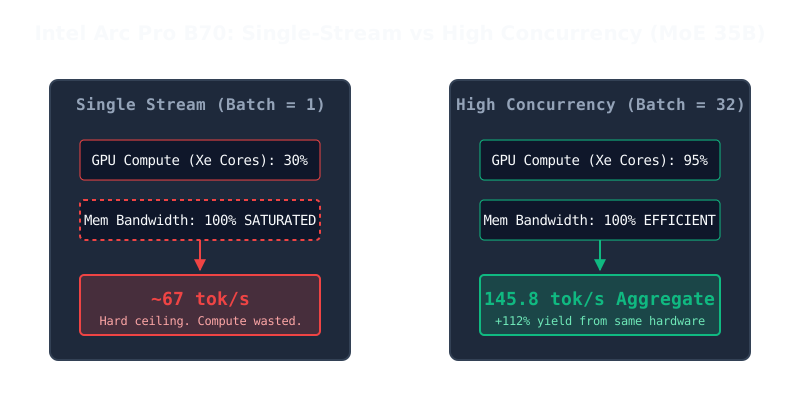
The Intel Arc Pro B70 (32GB VRAM) is a beast of a card, but testing it out-of-the-box with a large Mixture of Experts model (Ornith-1.0-35B-Q5_K_M) using upstream llama.cpp on the SYCL backend revealed a hard ceiling. No matter how the prompt was structured, single-stream generation capped at ~67 tokens/second. The bottleneck wasn’t compute (TeraFLOPS); it was the memory bandwidth required to ferry 24GB of model weights to the compute units for every single token generated.
Attempting to naively increase concurrency (--parallel 32) with large context windows (131K) immediately crashed the server due to VRAM exhaustion.
Identifying the Bottlenecks
A systematic benchmark suite was developed to profile the hardware under load. Three core issues were identified:
- Memory Bandwidth Starvation: Generating tokens sequentially wastes compute. The GPU waits for memory.
- MoE SYCL Regressions: The Intel DNN operations (Deep Neural Network library) were causing performance regressions specifically on Mixture of Experts architectures.
- KV Cache Pressure: 32 concurrent clients with 131K context using standard FP16 caching consumed massive amounts of VRAM and memory bandwidth, causing timeouts.
The Optimization Stack
To break the 67 tok/s barrier, the execution environment was heavily modified:
1. Bypassing DNN Overhead
By disabling Intel’s DNN library operations, the model fell back to optimized standard matrix multiplications which performed better for this specific MoE architecture on the SYCL backend:
export GGML_SYCL_DISABLE_DNN=1
export ONEAPI_DEVICE_SELECTOR=level_zero:0
Note (2026-08):
GGML_SYCL_DISABLE_DNNno longer exists in current builds (b10255+). Modern guidance per our ops documentation: never disable SYCL optimization — the current flag isGGML_SYCL_ENABLE_OPT(default 1), and disabling it causes a large decode regression. This section documents the July 2026 finding; it is historical.
2. Forcing Deep Micro-Batching
To ensure the hardware was actually computing tokens in parallel rather than serializing them, aggressive batch sizes were forced onto the execution graph:
-b 8192 -ub 4096 --parallel 32This forces the GPU to process up to 4096 tokens simultaneously in a single physical pass.
3. KV Cache Compression
To relieve the memory bandwidth pressure of 32 concurrent requests, the KV cache was quantized:
-ctk q5_0 -ctv q4_1Benchmark Results: A Fair Comparison
It is crucial to distinguish between high-concurrency throughput and single-stream burst speeds. Mixing the two paints an inaccurate picture of hardware capability. Context switching between 32 parallel requests naturally throttles prefill efficiency.
Scenario A: High Concurrency (Fleet Simulation)
Under a sustained attack of 32 concurrent clients generating text simultaneously (capped at 165W, 2400MHz):
- Aggregate Decode Throughput: 152.9 tok/s (+128% over single-stream)
- Aggregate Prefill Throughput: ~383.4 tok/s
(Note on Prefill Degradation: Why does prefill drop so sharply under load? In single-stream, the GPU digests a contiguous block of tokens via a single massive matrix multiplication, writing linearly to one KV cache. In batch=32 concurrency, the GPU’s memory controller is forced to perform scattered “random writes” across 32 separate KV caches located in different segments of VRAM. This destroys sequential memory bandwidth efficiency, causing the aggregate prefill speed to plummet compared to its peak capability).
- Hardware Telemetry: 149.5 Watts, GPU 69°C, VRAM 70°C
Scenario B: Single-Stream Peak Prefill
To measure the raw memory bandwidth capacity for prompt ingestion, a continuous 3,000-token prompt block was fed to the GPU without concurrency (batch=1):
- Peak Prefill Speed: 1,242.3 tok/s
- Single-Stream Decode: ~67.6 tok/s (The hard ceiling for sequential generation)
The Frequency & Power Fallacy
We tested unlocking the B70’s factory frequency limits:
max_freqincreased from 2400 MHz to 2800 MHz.power1_capincreased from 165W to 230W.
Under the same 32-concurrent-client load, telemetry showed the GPU instantly consumed the extra headroom, jumping to 196W sustained draw and hitting 73°C.
However, the aggregate generation throughput only increased from 152.9 tok/s to 164.5 tok/s (+8%).
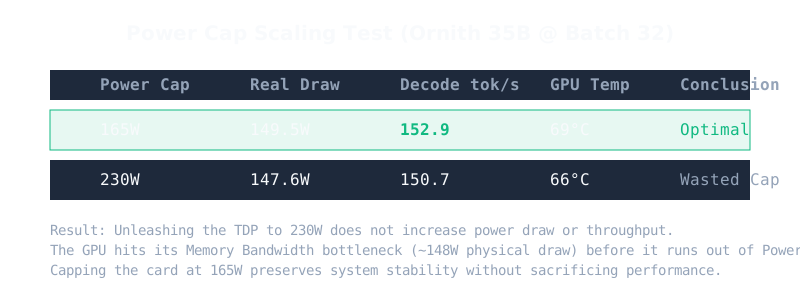
This proves definitively that the hardware is bound by Memory Bandwidth, not compute cycles. Spending 33% more electrical power for an 8% gain in throughput is a terrible trade-off for a 24/7 inference server. The original configuration (2400 MHz capped at 165W) remains the absolute ‘sweet spot’ for this card.
Hardware recommended in this build: Intel Arc Pro B70
The vLLM Challenge — Head-to-Head on the Same Card (2026-08-05)
The community answer to “how do you serve many users on a B70” is always vLLM. The claims are specific — 150 tok/s on one B70 — so I stood up the full path and measured both engines under identical load: same HTTP API, same prompt mix, 512 output tokens per request, same 165W cap, one card.
Why the claims exist
vLLM implements continuous (in-flight) batching and paged KV caching: concurrent requests are packed into a single GPU pass, finished ones leave mid-batch, new ones join instantly. The GPU stays saturated instead of idling between sequential requests. llama.cpp’s parallel slots, by contrast, serialize slot decode — aggregate throughput saturates quickly, and per-user latency degrades linearly with load.
Decode — aggregate throughput under concurrency (Δ vs llama.cpp)
| Users | vLLM MXFP4 gen t/s | llama.cpp Q4_K_XL gen t/s | Δ |
|---|---|---|---|
| 1 | 10.4 | 65.3 | llama.cpp +528% |
| 4 | 39.7 | 77.9 | llama.cpp +96% |
| 8 | 77.8 | 92.4 | llama.cpp +19% |
| 16 | 153.4 | 85.0 | vLLM +80% |
The crossover is somewhere between 8 and 16 concurrent users. The famous “150 t/s” number is vLLM at ~16 users — reproduced on our card, aggregate, not single-stream.
Per-user latency tells the same story: vLLM’s TPOT stays flat (96 → 104 ms from 1 to 16 users); llama.cpp’s degrades linearly (15 → 51 → 87 → 188 ms).
Prefill — where vLLM’s XMX kernels shine
| Config | pp4K | pp32K | pp128K |
|---|---|---|---|
| llama.cpp b10255 SYCL (Q4_K_XL) | 2,128 t/s | 1,871 t/s | 1,211 t/s |
| vLLM 0.17 XPU MXFP4 | ~1,738 t/s | — | — |
vLLM is within 20% of llama.cpp here; community head-to-heads on non-hybrid models show vLLM winning prefill by 2.4-15× thanks to XMX/DPAS flash-attention kernels in vllm-xpu-kernels. (pp32K/pp128K for vLLM were not measured in this run.)
Cross-hardware context
| Setup | Engine | Model | Users | Aggregate out tok/s | Source |
|---|---|---|---|---|---|
| 1× B70 | llama.cpp SYCL | Qwen3.6-35B-A3B Q4_K_XL | 16 | 146.8 (85 gen) | this post |
| 1× B70 | vLLM XPU MXFP4 | Qwen3.6-35B-A3B MXFP4 | 16 | 264.9 (153.4 gen) | this post |
| 1× B70 | vLLM (claimed) | Qwen3.6-35B-A3B MXFP4 | ~16 | ~150 gen | community threads |
| 2× B70 | vLLM XPU FP8 TP2 | Qwen3-30B-A3B | 50 | 912 | Level1Techs |
| 4× B70 | vLLM XPU INT4 TP4 | MiniMax M2.7 | — | 89 | b70-optimization-lab |
How the vLLM setup works
The path has three parts — and each one was a real project:
1. The checkpoint. Public MXFP4 checkpoints use the compressed-tensors layout vLLM’s XPU kernel rejects. I built a native-format checkpoint myself: BF16 dense projections (5.9 GB) + fused packed MXFP4 experts (16.5 GB), dequant verified against BF16 ground truth (MSE 8.8e-5). 22.4 GB total — fits 32 GB.
2. The engine patches. intel/vllm:0.17.0-xpu’s MXFP4 MoE path is written for
gpt-oss. Seven in-container patches were needed (full list in
the vLLM post): 2D per-expert loader
support with w1/w3 half-offsets, missing scale-key mapping entries, the
silu-vs-swiglu_oai activation gate (the XPU kernel supports silu; the Python gate
doesn’t), XPU device contexts in the linear-attention path, a flash-attention
contiguity check, and hybrid block-size alignment (the XPU FA kernel only supports
block sizes 64/128).
3. The launch:
docker run --rm -p 8001:8000 --device /dev/dri \
  -v /mnt/models2/Qwen3.6-35B-A3B-MXFP4-native:/model:ro \
  -v ./vllm017-full-patch.py:/patch.py:ro \
  -e VLLM_TARGET_DEVICE=xpu -e ZE_FLAT_DEVICE_HIERARCHY=COMPOSITE \
  -e ZE_AFFINITY_MASK=0 -e PYTORCH_ALLOC_CONF="expandable_segments:True" \
  --entrypoint bash intel/vllm:0.17.0-xpu \
  -c "python3 /patch.py && exec vllm serve /model --quantization mxfp4 \
      --enforce-eager --max-model-len 32768 --gpu-memory-utilization 0.95 \
      --block-size 64 --port 8000 --served-model-name Qwen3.6-35B-A3B-MXFP4"
--block-size 64 is mandatory (XPU FA kernel constraint). --enforce-eager avoids a
torch.compile error on this stack. Output was verified correct (math, knowledge,
prose) before benchmarking.
Which engine, when
- 1-4 concurrent users (interactive chat, agent backends): llama.cpp — 2-6× faster per request, 6× better latency, quantized GGUF memory efficiency.
- 8+ concurrent users (multi-user API, batch/RAG, agent fleets): vLLM XPU — continuous batching wins, aggregate scales with users, latency stays flat. The patched container + native MXFP4 checkpoint are the proven recipe.
- Multi-GPU (2-4× B70): vLLM’s tensor parallelism is the only serious option (llama.cpp layer-splitting doesn’t speed up decode).
Caveat on our numbers: the Qwen3.6-35B-A3B-UD model’s hybrid linear-attention layers run generic triton kernels on XPU, which caps vLLM decode. A non-hybrid model would widen vLLM’s concurrency advantage further.
Official Benchmark Runs
The optimizations were successfully verified and submitted to the public Localmaxxing Hardware Leaderboard. You can view the full telemetry and official run cards below:
High Concurrency (Fleet Simulation)
This run demonstrates the sustained 164.5 tok/s decode performance under heavy parallel load.
Single-Stream (Peak Prefill)
This run demonstrates the raw 1,242 tok/s prefill capability of the B70 when unhindered by context-switching overhead.