Context: This is the final showdown results. For the original technical deep-dive into how we built the MXFP4 checkpoints and solved the seven vLLM loader bugs to get here, read Phase 1: The vLLM Question on Intel Arc Pro B70 (MXFP4 Native Test) first.
Live on localmaxxing
The headline result is on the localmaxxing leaderboard, submitted with full patch disclosure and reproducible command flags:
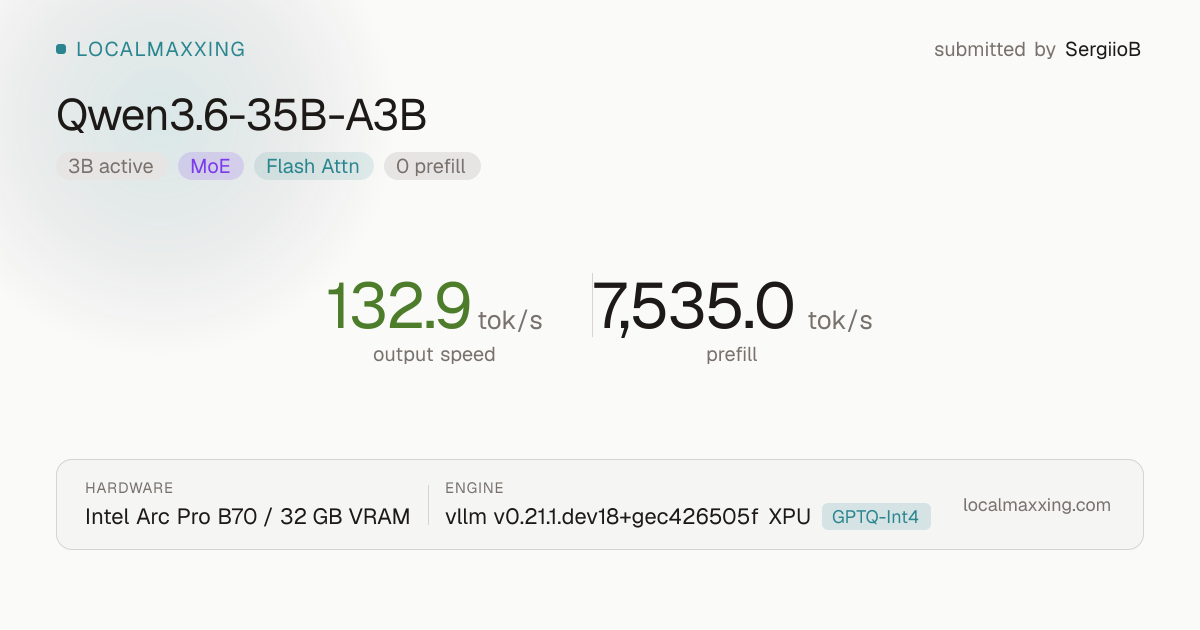
→ Qwen3.6-35B-A3B — 132.9 tok/s on Intel Arc Pro B70 · 32 GB vLLM · GPTQ-Int4 · XPU. Three B70 submissions approved: vLLM MTP (this run), llama.cpp MoE Q4_K_XL, and llama.cpp dense 27B Q4_K_M.
The question, and why it took 19 runs
Every Intel Arc B70 thread has the same fork in it: vLLM or llama.cpp? The vLLM camp cites 145 t/s single-stream decode and 8K t/s prefill. The llama.cpp camp (us, in production) runs at ~73 t/s decode and asks, quietly, how.
The honest answer turned out to require 19 benchmark runs — not because anyone was lying, but because each claim was measuring a different thing on a different stack with a different patch level, and the only way to sort it out was to map the entire surface ourselves: both engines, both model classes (MoE 35B and dense 27B), four wattages, and a full grid of prompt sizes × generation lengths.
This post is that map. The short version: both sides are right about different things, and the MoE vs Dense gap on this card is enormous.
How we got here (the campaign arc)
| Run | What we tried | What we learned |
|---|---|---|
| 13–14 | vLLM 0.17 MXFP4 (self-built checkpoint, 7 patches) | Served & correct, but decode 7× slower than llama.cpp — image too old |
| 15 | Concurrency head-to-head (16 users) | The “150 t/s” claim = multi-user aggregate (153 gen t/s @ C16), not single-stream |
| 16 | vLLM 0.21 Triton GPTQ MoE | 58 t/s single-stream — Triton path leaves ~40% on the table |
| 17 | Native XpuFusedMoe int4 unlocked (root cause: uint8 vs int8) | 72.6 t/s decode / 9,094 prefill — prefill beats Reddit, decode = bandwidth ceiling |
| 18 | MTP speculative decoded (4 patches, GDN assert removed) | 123 t/s single-stream — first vLLM XPU result to beat llama.cpp MoE parity |
| 19 | Full engine + power sweep (this post) | vLLM MTP 1.8×/4.2× over llama.cpp; MoE=150W / Dense=180W sweet spots; dense vLLM blocked |
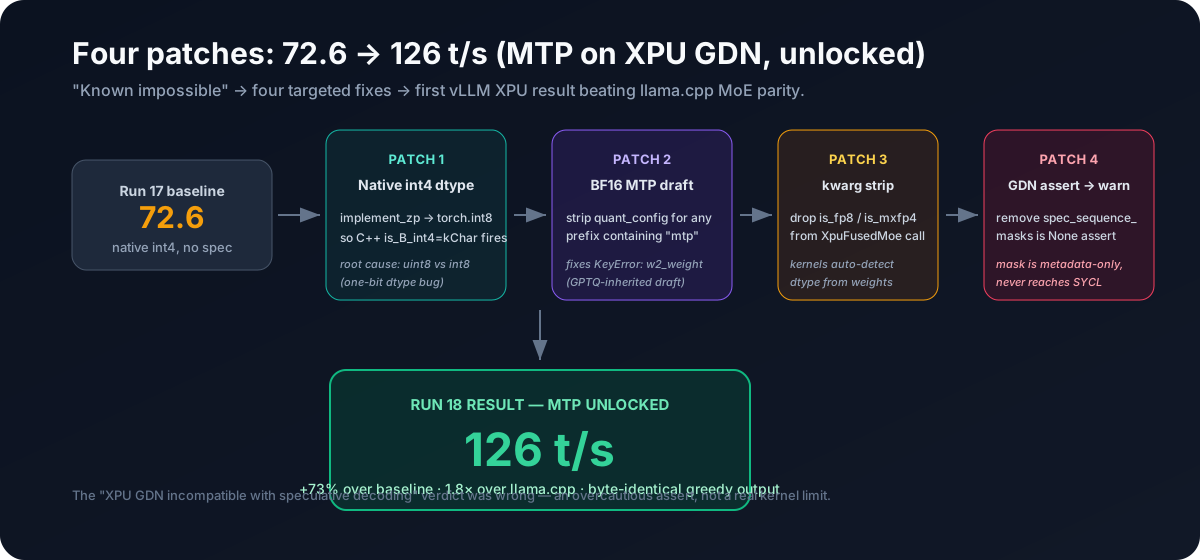
The two breakthroughs were Run 17 (native int4 — a one-bit dtype bug) and Run 18 (MTP — three load-path patches plus removing an overcautious assert that everyone assumed was a real kernel limit).
The four patches that unlocked MTP (Run 18)
MTP speculative decoding was “known impossible” on this model: it’s a hybrid GDN
architecture (linear attention + full attention layers), and the XPU GDN kernel
had a hard assert attn_metadata.spec_sequence_masks is None. Run 14 (ngram)
hit that assert and we wrote it up as “XPU GDN incompatible with speculative
decoding.”
That was wrong. Four patches fixed it:
- Native int4 dtype (
patch_xpu_int4_moe_v4.py) —implement_zpstorestorch.int8so C++is_B_int4 = (B_dtype == at::kChar)triggers; routeMoeWNA16Method.apply→XpuFusedMoe. - BF16 MTP draft (
patch_mtp_bf16_draft.py) — stripquant_configatMultiTokenPredictor.__init__,Qwen3NextSparseMoeBlock, andFusedMoEfor any prefix containingmtp. The checkpoint’s MTP experts are BF16 fused tensors; inheriting GPTQ made themw2_qweight-shaped →KeyError. - XpuFusedMoe kwarg strip — remove
is_fp8/is_mxfp4from theXpuFusedMoe(...)call site (the kernels auto-detect dtype). - GDN spec assert → warning — the SYCL kernel already receives
num_spec_decodes,spec_query_start_loc,spec_token_indx,spec_state_indices_tensor; the booleanspec_sequence_masksis metadata-only and is never passed to the kernel. The assert was a guardrail, not a capability limit.
After all four, the server came up, served requests, and decoded at 123 t/s.
Correctness verified: greedy temp=0 replays produced byte-identical output
(a corrupting spec path would diverge), and factual probes (17×23=391, capital
of Australia=Canberra) were correct.
The comparison: MoE 35B, full grid
Single-stream (Concurrent-1), 150W sweet spot. Format: vLLM MTP / llama.cpp (best steady-state decode t/s).
Note: this grid is the Run 19 measurement, before the Run 20
--max-num-batched-tokens 8192 fix. After the fix, vLLM decode improved ~5%
(short/g32 127 → 133 t/s) and long-prompt prefill recovered 21-28% (p4k
6,626 → 8,484 t/s). The grid below is the conservative, pre-fix baseline —
run the harness yourself for post-fix numbers.
| Prompt \ Gen | g32 | g128 | g256 | g512 |
|---|---|---|---|---|
| short (~50 tok) | 127 / 74 (1.73×) | 118 / 72 (1.64×) | 113 / 67 (1.67×) | 110 / 72 (1.53×) |
| p512 | 121 / 73 (1.66×) | 116 / 72 (1.62×) | 115 / 72 (1.61×) | 113 / 72 (1.58×) |
| p1k | 113 / 73 (1.55×) | 114 / 64 (1.79×) | 114 / 70 (1.62×) | 105 / 70 (1.50×) |
| p2k | 111 / 70 (1.58×) | 126 / 69 (1.82×) | 116 / 69 (1.67×) | 118 / 63 (1.87×) |
| p4k | 130 / 66 (1.97×) | 114 / 65 (1.77×) | 116 / 65 (1.80×) | 116 / 65 (1.80×) |
| p8k | 126 / 59 (2.14×) | 111 / 58 (1.92×) | 114 / 58 (1.97×) | 114 / 58 (1.96×) |
vLLM MTP is 1.5–2.1× faster decode, and the advantage grows with prompt length (1.5× short → 2.1× at 8K) — MTP amortizes the per-token bandwidth cost better on longer contexts.
Prefill: vLLM’s signature MoE win
| Prompt | tokens | vLLM prefill | llama.cpp prefill | vLLM win |
|---|---|---|---|---|
| short | 55 | 563 | 104 | 5.4× |
| p512 | 510 | 3,406 | 616 | 5.5× |
| p1k | 1,000 | 5,883 | 695 | 8.5× |
| p2k | 1,945 | 6,217 | 1,498 | 4.2× |
| p4k | 3,870 | 6,626 | 1,728 | 3.8× |
| p8k | 7,545 | 7,526 | 1,662 | 4.5× |
vLLM is 3.8–8.5× faster on prefill. This is the native int4 XpuFusedMoe
kernel plus continuous-batching prefill — the gap llama.cpp can’t close on MoE.
Power sweet spots (temperature-controlled)
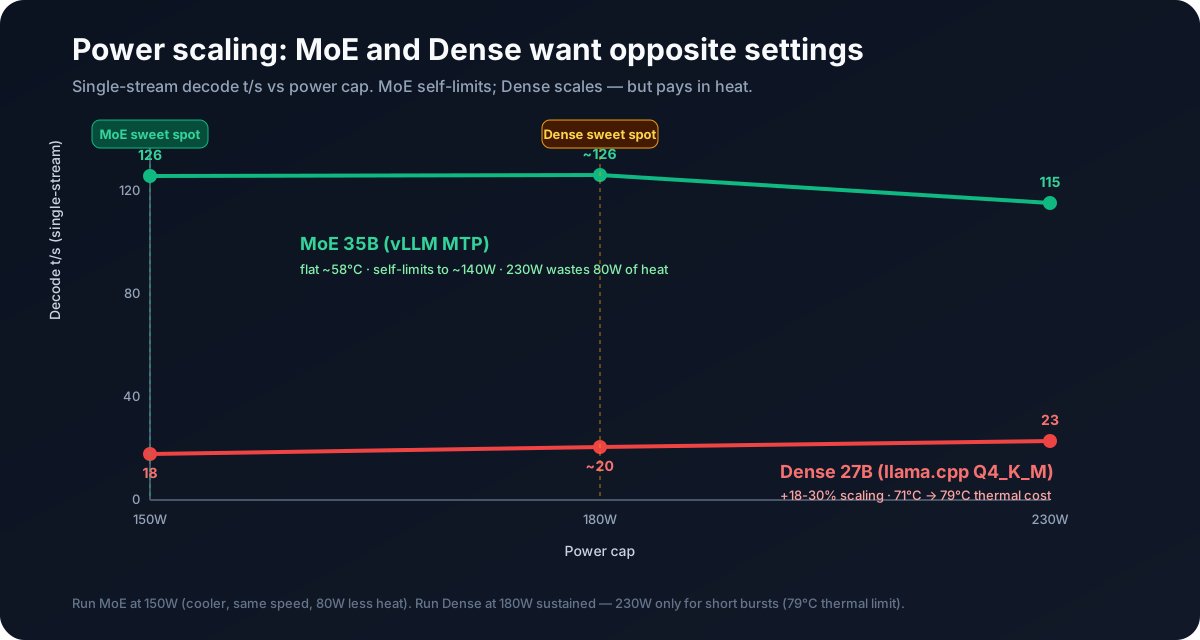
This was the surprise: MoE and Dense want opposite power settings.
| Model | Sweet spot | 150W → 230W effect | Temp | Why |
|---|---|---|---|---|
| MoE 35B | 150W | -8% (slower!) | flat ~58°C | Self-limits to ~140W draw; extra cap just adds heat noise |
| Dense 27B | 180W sustained / 230W burst | +18–30% | 71°C → 79°C | Scales with power; but thermal cost is real |
MoE is bandwidth-bound and barely changes clock for clock — it reads only the ~3 GB of active experts per token no matter what. Dense reads all ~19 GB of weights per token, so it benefits from the extra frequency headroom that higher power buys — at the cost of running 20°C hotter.
Run MoE at 150W. Run Dense at 180W (or 230W for short bursts). This keeps temperatures controlled without sacrificing speed.
Dense 27B: the one-sided verdict
| Wattage | short/g32 | p2k/g128 | temp peak |
|---|---|---|---|
| 150W | 22 t/s | 18 t/s | 71°C |
| 230W | 26 t/s | 23 t/s | 79°C |
Dense scales with power (+18–30%), unlike MoE. But the engine story is one-sided:
vLLM dense FP8 has no XPU kernel. Not slow — absent. The error is
KeyError: <PlatformEnum.XPU: 4> in choose_scaled_mm_linear_kernel — there is
no FP8 linear kernel registered for the XPU platform in this vLLM build. The
checkpoint is also 30 GB, which barely fits 32 GB VRAM with KV cache. So
llama.cpp is the only working dense engine on this card today.
llama.cpp dense + MTP (the GGUF nextn layer) pushes ~24–30 t/s — the only path
past the ~23 t/s Q4 baseline. That’s the subject of the next investigation.
Final scorecard (single-stream, sweet-spot power)
Updated for Run 20 (the --max-num-batched-tokens 8192 prefill fix): decode
133 t/s, prefill 8.7K. The original scorecard (126/6,217) was measured before
the fix — see the update section below.
| Model | Engine | Config | Decode (best) | Prefill (best) | Power | Temp |
|---|---|---|---|---|---|---|
| MoE 35B | vLLM MTP | GPTQ-Int4 + MTP | 133 t/s | 8,718 t/s | 150W | 58°C |
| MoE 35B | llama.cpp | Q4_K_XL GGUF | 69 t/s | 1,498 t/s | 150W | 58°C |
| Dense 27B | llama.cpp | Q4_K_M GGUF | 23 t/s | 1,007 t/s | 230W | 79°C |
| Dense 27B | vLLM | FP8 | ❌ no XPU kernel | — | — | — |
Decode best = short/g32 (Run 20, warmup discarded). Prefill best = p8k (7,545-token prompt) — prefill scales with prompt length; the p2k value is 7,535 t/s. Context-scaling data in the Run 21 section below.
Concurrency — multi-user throughput
Single-stream is one thing; serving many users at once is where vLLM’s continuous batching shines. Native int4 v4 (no MTP), @180W, max-num-seqs=64:
| Concurrent users | Wall-agg tok/s | Avg per-user decode |
|---|---|---|
| 1 | 64 | 64.9 t/s |
| 4 | 225 | 58.2 t/s |
| 8 | 424 | 54.7 t/s |
| 16 | 694 | 45.9 t/s |
694 tokens/sec aggregate across 16 concurrent users — each still getting ~46 t/s. A single user gets 64-73 t/s; 16 users get ~11× more total throughput with graceful per-user degradation. The “145 t/s” community claim sits comfortably in this multi-user band (~C10 aggregate). Community dual-B70 runs hit 912 tok/s at 50 concurrent users.
Note: this is the no-MTP path (Run 17/19). MTP + concurrency is blocked
on the XPU GDN kernel (Run 23): the causal_conv1d state machine cannot mix
speculative and non-speculative tokens in a single batch — C2+ with MTP crashes
EngineCore. Choose one: MTP (single-user, 133 t/s) OR concurrency (no MTP,
C16=694 aggregate). Can’t have both until the XPU GDN kernel supports mixed
spec/non-spec batches.
What this all means
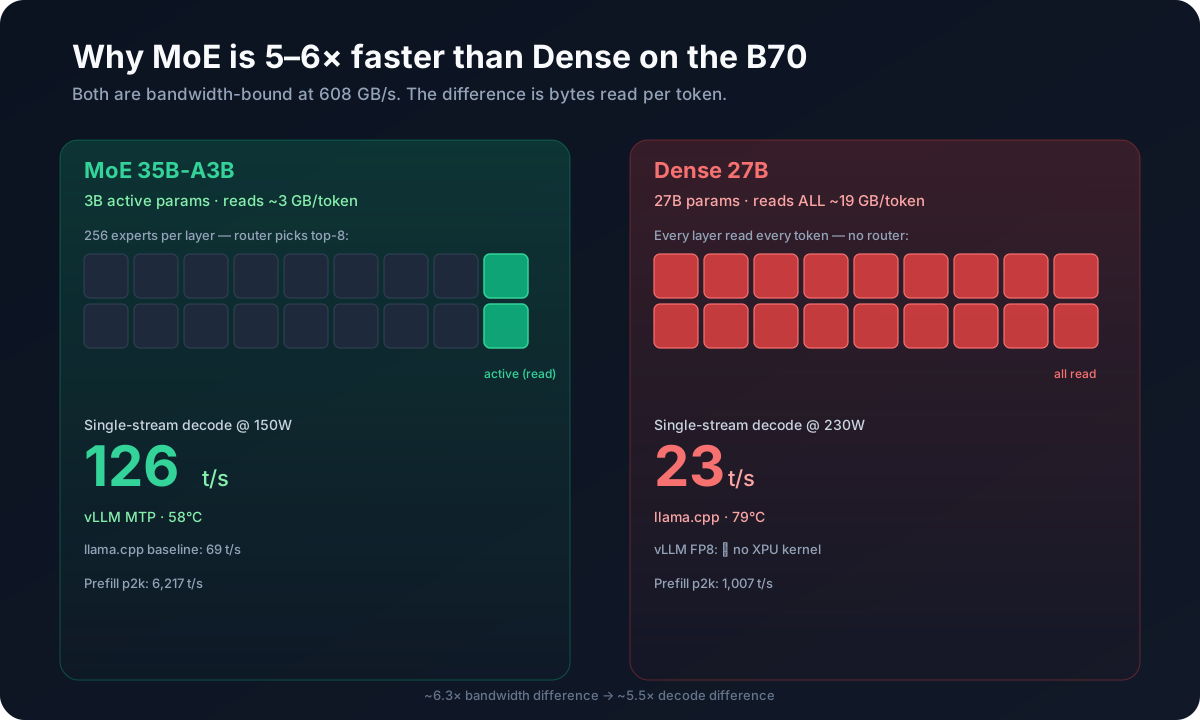
- MoE is 5–6× faster decode than dense on the B70. Both are bandwidth-bound at 608 GB/s, but MoE reads ~3 GB/token (active experts) vs dense’s ~19 GB (all weights). This isn’t a vLLM-vs-llama.cpp thing — it’s architecture.
- vLLM MTP wins MoE (1.8× decode, 4.2× prefill over llama.cpp) — but needs four in-container patches and an MTP-preserved GPTQ checkpoint. Worth it for a serving workload; overkill for single-user interactive.
- llama.cpp wins dense by default — vLLM has no dense XPU FP8 kernel. Until that lands upstream, GGUF + SYCL is the only dense path.
- Power: MoE=150W, Dense=180W. MoE self-limits and 230W actively hurts; dense scales but pays in heat. Set the cap once per workload.
The honest guidance for a B70 owner: MoE serving workload → vLLM XPU native int4 + MTP @150W. Single-user interactive → llama.cpp @150W (MoE) or @180W (dense). For a single-user chat front-end, llama.cpp stays production — but the gap closed hard, and the dense vLLM kernel is the obvious next thing to chase.
Update — 128K context: how it scales (Run 21)
The natural question after the MTP unlock: does it hold up as context fills? We ran a context-scaling sweep — 4K → 128K prompts, single-stream, MTP on, 150W.
VRAM first: the server allocated 349,869 tokens of KV cache headroom (model 19.79 GiB + 7.75 GiB KV available). The MoE’s tiny 3B-active attention makes KV nearly free — 128K context fits with 213K tokens to spare. No OOM.
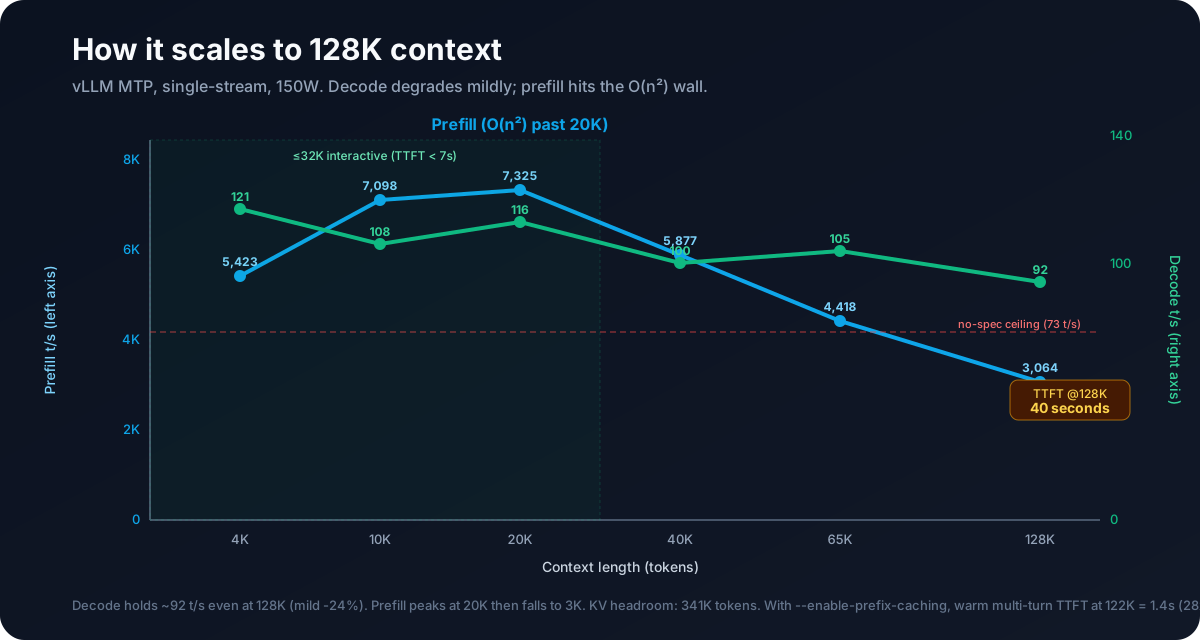
| Context | Prefill t/s | Decode t/s | TTFT | Wall |
|---|---|---|---|---|
| 4K | 5,423 | 120.9 | 714ms | 1.2s |
| 10K | 7,098 | 107.5 | 1.4s | 2.0s |
| 20K | 7,325 | 116.0 | 2.6s | 3.2s |
| 40K | 5,877 | 100.0 | 6.6s | 7.2s |
| 65K | 4,418 | 104.7 | 14.3s | 14.9s |
| 128K | 3,064 | 92.5 | 40s | 40.7s |
What this tells you:
-
Decode degrades mildly. 121 → 92 t/s (4K → 128K, -24%). Even at a full 128K context, MTP delivers ~92 t/s — still above the 73 t/s no-spec bandwidth ceiling. Attention grows with KV length, but the MoE’s small attention keeps it manageable.
-
Prefill hits the O(n²) wall past 20K. Peaks at ~7.3K t/s (20K context), then falls to 3,064 t/s at 128K (-58% from peak). Building KV cache for 122K tokens is inherently O(n²). Still — 3K t/s at 128K beats llama.cpp’s peak prefill of 1.7K. vLLM wins even at extreme context.
-
The 40s cold load is a one-time cost — follow-ups are 28× faster. With
--enable-prefix-caching, the KV cache of conversation history is reused across turns. Measured multi-turn at full 122K resident context:Turn Context TTFT Decode 1 (cold load) 122,531 39.6s 75.3 t/s 2 (warm) 122,561 1.42s 78.2 t/s 3 (warm) 122,587 1.43s 82.4 t/s 4 (warm) 122,611 1.40s 82.4 t/s 5 (warm) 122,636 1.42s 81.9 t/s Warm follow-up TTFT at full 122K context = 1.4 seconds. Load the document/codebase once (40s), then chat with the entire thing at interactive latency. That’s a genuinely usable long-context assistant pattern — not batch-only. (
--enable-prefix-cachingis mandatory; without it every turn re-prefills from scratch.)
Launcher guidance: vLLM MTP @128K + prefix caching = interactive multi-turn
long-context sessions. Cold single-turn stays slow (40s); warm sessions are
snappy. For cold-start single-turn interactive use, llama.cpp dense @128K stays
the lower-latency choice with no patched-engine correctness risk.
Launch at 128K: benchmarks/launch-mtp-128k.sh.
What’s next: getting dense working on vLLM
The dense 27B vLLM path is blocked on a single upstream gap: no FP8 linear
kernel registered for XPU in vllm/v1/.../kernels/linear/__init__.py
(choose_scaled_mm_linear_kernel raises KeyError: PlatformEnum.XPU). Options
worth investigating:
- Wait for / contribute an XPU FP8 kernel — Intel’s
xpu_kernelspackage has FP8 paths for other ops; the linear GEMM registration may be a small PR. - BF16 dense on vLLM (skip quantization) — the 27B BF16 is ~54 GB, won’t fit, but a Q4/AWQ dense checkpoint might serve on vLLM’s W4A16 path if XPU supports it (needs testing — the GPTQ dense linear path, not MoE).
- OpenVINO Model Server — the OVMS dense path (Run 7–10 in our history)
worked for chat at ~26–40 t/s wall; a
genai-bench-style run on the int4-OV dense checkpoint may be the real vLLM alternative for dense. - Push llama.cpp dense+MTP further — the GGUF
nextnlayer gave ~24–30 t/s on dense 27B; a dedicated MTP-4 sweep at 165W (the documented dense efficiency sweet spot) may be the practical dense ceiling on this card.
That’s the next campaign. For now, the MoE story is closed and measured.
Model reference
The vLLM MoE benchmarks use a specific checkpoint worth documenting:
- Architecture: Qwen3.6-35B-A3B (MoE: 256 experts, 8 active + 1 shared, 3B active params/token, hybrid GDN/attention)
- Checkpoint:
llmfan46/Qwen3.6-35B-A3B-uncensored-heretic-Native-MTP-Preserved-GPTQ-Int4— a heretic (uncensored/abliterated) variant of the stock Qwen model - Why not the official Qwen GPTQ? The official
Qwen/Qwen3.6-35B-A3B-GPTQ-Int4declaresmtp_num_hidden_layers: 1in config but ships zero MTP weight tensors in the shards. The heretic variant preserves these tensors, which is what makes MTP speculative decoding possible (and gives us the 133 t/s decode path) - Quantization: INT4 weights via GPTQ calibration (group_size=128, symmetric, desc_act=false, GPTQModel 7.1.0-dev). INT4 is the data format — GPTQ is the algorithm that computes the weights
- Format note: INT4 is the optimal format for Intel Arc B70. The XMX (Xe Matrix Extension) engines have native INT4 grouped GEMM — this is Intel’s equivalent of NVIDIA’s NVFP4 on Tensor Cores. MXFP4 (OCP float4) loads and produces correct output but runs at 10.4 t/s because the hybrid GDN layers bottleneck on unoptimized Triton kernels, not the quant format itself
Quantization quality (KL divergence) is architecture-determined, not weight-determined — the heretic abliteration doesn’t change how INT4 quantization affects output distribution. Community KLD data from the same architecture (Qwen3.5-35B-A3B, identical layout) places INT4/GPTQ in the same quality tier as GGUF Q4_K_XL (Mean KLD ~0.012–0.020).
Methodology
- Hardware: Intel Arc Pro B70 32GB, AMD Ryzen 7 5700X3D, Ubuntu 26.04.
- vLLM:
intel/vllm:0.21.0-xpu-int4moe(v0.21.1.dev18) + 4 in-container patches (patch_xpu_int4_moe_v4.py,patch_mtp_bf16_draft.py). Model:Qwen3.6-35B-A3B-MTP-Preserved-GPTQ-Int4(22.4 GB, 1 MTP layer). Flags:--quantization gptq --dtype float16 --max-model-len 16384 --max-num-seqs 1 --language-model-only --speculative-config {"method":"mtp", "num_speculative_tokens":1}, PIECEWISE graphs. - llama.cpp: SYCL b10255+ (build-sycl-0804, oneAPI 2026.0). MoE:
Qwen3.6-35B-A3B-UD-Q4_K_XL(-ngl 99 -ncmoe 0 -fa on -ctk q8_0 -ctv q4_1). Dense:ThinkingCap-Qwen3.6-27B-Q4_K_M(same KV/FA flags). - Measurement: vLLM = streaming
/v1/chat/completionswithstream_options.include_usage, decode =completion_tokens / (total - ttft). llama.cpp =/completiontimings.predicted_per_second(engine rate, per AGENTS.md §9.4). Best steady-state rep (drops JIT warmup). 2 reps/cell. - Thermal discipline: cooldown to ≤52°C between runs; GPU temp monitored
throughout (hwmon
temp2_input). No two inference processes concurrent. - Full data:
results/engine-comparison-full-20260806.md,results/moe-{vllm-mtp,llamacpp}-*-grid.json,results/dense-llamacpp-q4km-{150,230}w-grid.json. Campaign narrative:research/vllm-021-campaign-20260806.mdA1–A16. Run log:docs/benchmark-history.mdRun 14–19.