The Architecture of Speed: Real-Time Telemetry and Generative AI in 2026 Motorsport
In modern top-tier motorsport, a vehicle is no longer just an engineering marvel of aerodynamics and combustion—it is a hyper-fast, heavily connected IoT edge device. With the introduction of massive technical regulation changes in 2026 across both Formula 1 (F1) and Formula E (FE), the volume, velocity, and complexity of telemetry data have reached unprecedented scales.
The days of simply monitoring tire pressures and engine revs are long gone. Today, data engineering dictates the difference between a podium finish and a catastrophic failure. This post explores the end-to-end cloud infrastructures, real-time streaming topologies, and the cutting-edge Generative AI integrations powering the next generation of racing through F1’s partnership with Amazon Web Services (AWS) and FE’s partnership with Google Cloud Platform (GCP).
Executive Summary
- Formula 1 optimizes for sustained ingest throughput: massive shard fan-out, queue-based decoupling, and millisecond state lookups for race control and broadcast overlays.
- Formula E optimizes for burst tolerance and elasticity: edge buffering, resilient event buses, and HTAP databases that let live race state and analytics coexist.
- GenAI is not replacing telemetry engineering: it sits on top of mature streaming pipelines and converts fast-changing race state into narrative recommendations for humans.
The architectural lesson is broadly applicable outside motorsport: if your edge platform must survive packet loss, bursty writes, and sub-second analytics, you need to separate ingest, state, and inference concerns early.
1. The Challenge: Extreme High-Velocity Data
At speeds exceeding 220+ mph, latency is the ultimate enemy. Teams, race control, and broadcasters all require sub-second ingestion-to-insight pipelines. The scale of the data in 2026 demands entirely new paradigms in edge computing and cloud streaming.
- Formula 1 (2026 Regs): The 2026 power unit regulations introduced a 50/50 split between internal combustion and a massive 350kW electrical MGU-K system. Coupled with the introduction of Active Aerodynamics (where cars shift mid-corner between a low-drag X-Mode and a high-downforce Z-Mode), the sensor density has exploded. A single car now generates over 1.1 million data points per second across 300+ sensors. During a Grand Prix with 20 cars, that is 22 million data points hitting the ingest layer every single second.
- Formula E (GEN3 Evo): Formula E introduced sudden bursts of all-wheel drive (AWD) capabilities and intense regenerative braking zones. Because the series races on temporary street circuits with highly variable 5G/RF connectivity, the telemetry pipeline focuses heavily on fault tolerance. Each car generates 100,000+ data points per second, with an acute focus on high-voltage battery thermal dynamics and cell-level energy depletion rates.
What is actually inside the telemetry stream?
The phrase data points per second hides a complex mix of very different signal families:
- Power unit telemetry: internal combustion engine state, MGU-K deployment, inverter temperatures, torque demand, and energy recovery rates.
- Vehicle dynamics: steering angle, yaw rate, lateral/longitudinal G, suspension travel, brake pressure, and wheel-speed deltas.
- Aero and control surfaces: active aero state transitions, drag-reduction posture, and hydraulic/electronic actuator confirmations.
- Tire and thermal channels: carcass temperature, brake disc heat, battery pack temperatures, coolant loops, and thermal derate thresholds.
- Positional timing signals: sector timing, GPS-derived speed traces, track map correlation, and relative intervals to surrounding cars.
Not every signal is equally important. Some channels are sampled at extremely high frequency and feed live control and safety logic, while others are aggregated into slower analytical views used for broadcast graphics or pit wall strategy.
Why motorsport telemetry is harder than normal IoT
Most industrial telemetry systems care about seconds or minutes. Motorsport cares about corners. That changes the architecture dramatically:
- A queue spike at race start is not a minor slowdown; it can make overtake models irrelevant before Turn 1 is complete.
- Packet loss is not just missing observability; it can erase the exact state transition that explains a thermal event or battery anomaly.
- Historical context must be queryable immediately because engineers compare each lap against expected baselines in real time, not hours later.
That is why both Formula 1 and Formula E treat telemetry as a first-class production system rather than as a logging sidecar.
2. Formula 1 & AWS: Massively Sharded Streaming
To handle the immense data volume without throttling, Formula 1 employs a decoupled, horizontally scalable streaming architecture built on AWS. This system, internally dubbed “Track Pulse,” prioritizes unblocked ingestion and rapid parallel processing.
The Real-Time Pipeline
- Edge Ingestion & Global Backhaul: Telemetry is beamed via encrypted RF packets directly from the car to the trackside Event Technical Center (ETC). From the track, data is transmitted over dual, redundant 10-Gbps fiber-optic lines back to F1’s central Technical Center in Biggin Hill, UK.
- Sharded Ingestion (Amazon Kinesis): Raw telemetry hits Amazon Kinesis Data Streams. Because a single Kinesis shard is limited to ~1MB/sec or 1,000 records/sec, F1’s architecture dynamically spins up new shards horizontally. As data volume spikes (e.g., during the chaos of a race start), the Kinesis stream scales outward to absorb the load without dropping packets.
- Decoupling (Amazon SQS): To ensure downstream analytical systems aren’t overwhelmed if a sensor fails and starts spewing garbage data, or if a multi-car crash causes a sudden data surge, Amazon SQS (Simple Queue Service) acts as a crucial asynchronous buffer between the raw stream and the processing layer.
- Microservices & State Management (ECS & DynamoDB): The buffered stream is consumed simultaneously by hundreds of serverless AWS Lambda functions and Amazon ECS (Fargate) containers. These microservices calculate live metrics (like tire degradation curves). State data that requires millisecond retrieval—such as current track intervals and overtake probabilities—is continuously written to an ultra-fast Amazon DynamoDB NoSQL cache.
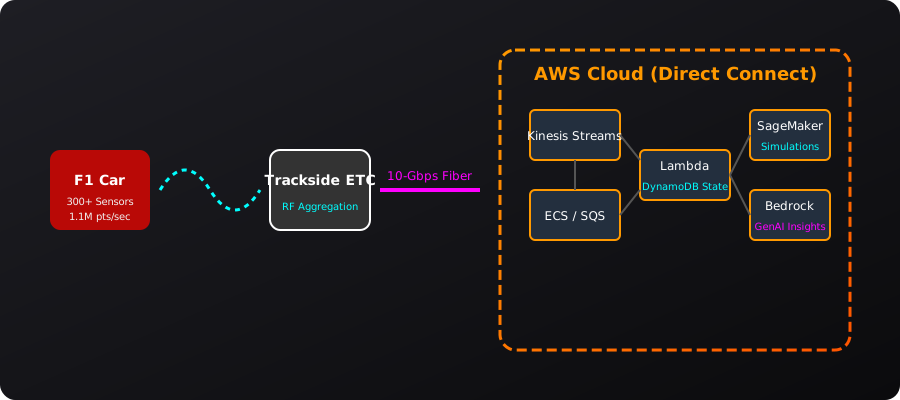
Open the full Formula 1 AWS telemetry SVG
Why this topology fits Formula 1
Formula 1’s operating model is dominated by continuous high-rate streaming from all cars at once. The key architectural requirement is not just low latency, but predictable low latency under saturation. Kinesis provides deterministic horizontal scale, SQS smooths transient spikes, and DynamoDB gives fast key-value access for race-state lookups that do not justify analytical joins.
This is a classic split between:
- Hot ingest paths that must never block.
- Operational state stores tuned for rapid lookups.
- Inference and simulation services that can scale independently from raw telemetry intake.
That separation is what prevents broadcast augmentation or strategy experimentation from interfering with primary race operations.
Deep technical breakdown: each Formula 1 AWS component
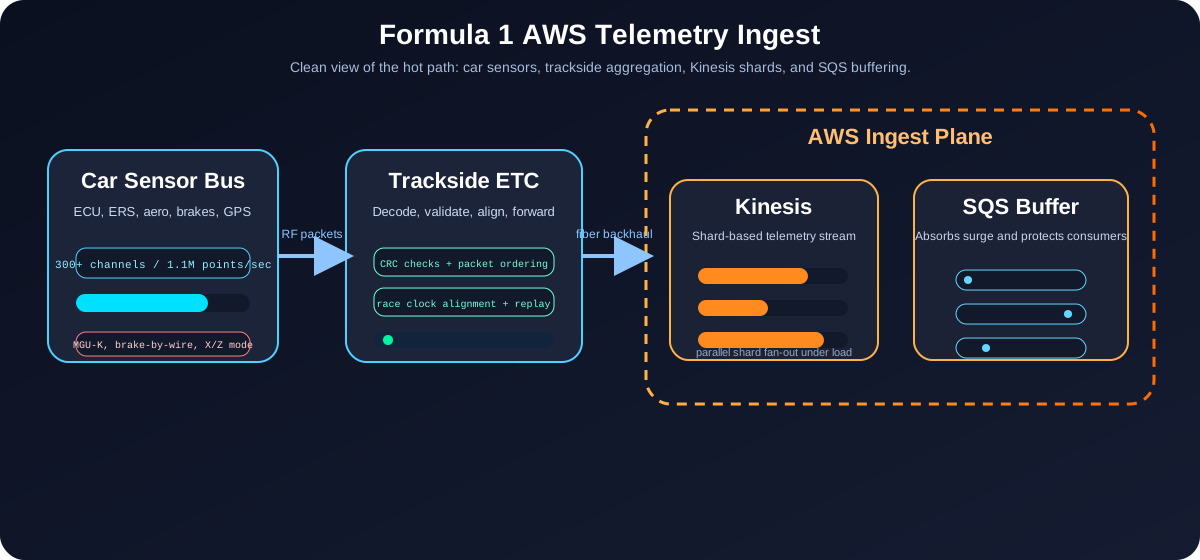
Open the Formula 1 AWS telemetry ingest SVG
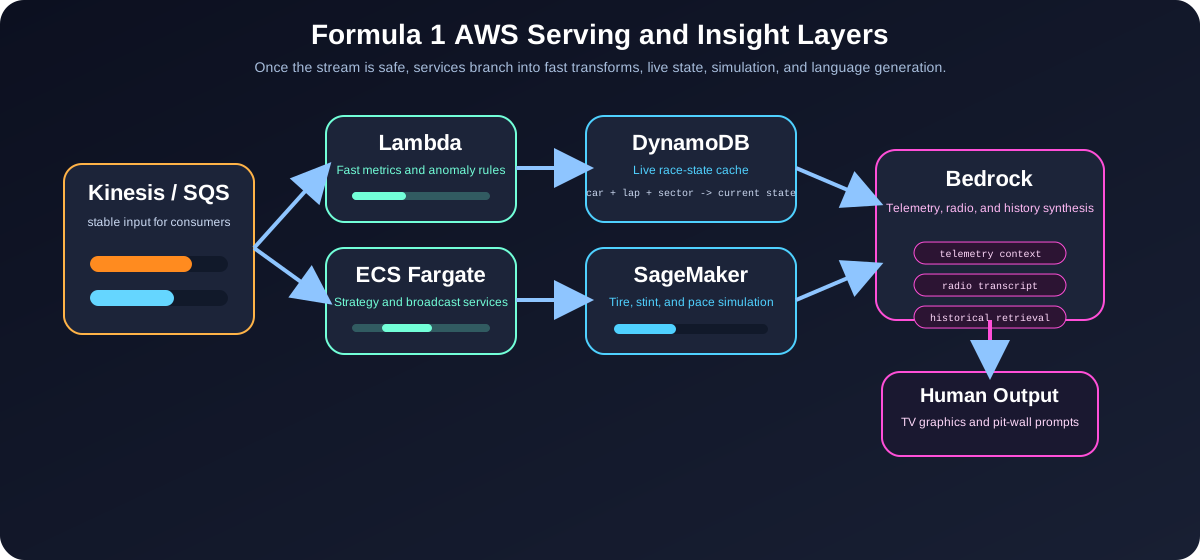
Open the Formula 1 AWS serving SVG
These two diagrams split the architecture into a clean ingest view and a clean serving view:
- Car Sensor Bus: This is the on-car acquisition layer, where ECU, battery, braking, GPS, and aerodynamic control signals are collected, normalized into packet structures, and tagged for uplink.
- Trackside ETC (Event Technical Center): This is the first reliable aggregation layer. It validates packet integrity, aligns timestamps, reconstructs ordering, and forwards the race stream over redundant backhaul.
- Amazon Kinesis Data Streams: The animated bars in the ingest SVG represent individual shards. Each shard is a bounded unit of throughput, so scaling throughput means increasing shard count and distributing producers/consumers accordingly.
- Amazon SQS: The moving dots in the ingest SVG visualize asynchronous shock absorption. SQS protects downstream calculators from ingest spikes caused by race starts, incidents, or bad sensors.
- AWS Lambda Metrics services: These are small, highly parallel functions used for fast transforms, anomaly checks, and compact derived metrics.
- Amazon ECS on Fargate: This block represents longer-lived services that maintain strategy logic, heavier joins, and outward-facing data products for engineering and broadcast consumers.
- Amazon DynamoDB: The cache layer stores race state in a form optimized for very fast key-based retrieval, such as
car_id + lap + sectorlookups. - Amazon SageMaker: This is where more computationally expensive predictive models belong, such as tire degradation curves, stint projections, or what-if strategy simulations.
- Amazon Bedrock: The GenAI layer sits downstream, combining numeric telemetry with contextual data such as radio transcripts and retrieved race history to create human-readable insight.
What the animation is meant to communicate in the F1 SVG
The motion is not decorative; it encodes system behavior:
- The animated sensor bar on the left shows telemetry density changing over time.
- The moving dots in the Kinesis and SQS sections show the difference between direct streaming throughput and queued buffering.
- The highlighted Bedrock box indicates that inference is a downstream consumer, not part of the hard real-time ingest loop.
In other words, the animation is showing where pressure builds, where it is absorbed, and where enriched outputs emerge.
Reading guide for the new F1 diagrams
The Formula 1 visuals are now intentionally split to avoid clipped boxes, tiny text, and overcrowding:
- Ingest SVG: Car Sensor Bus -> Trackside ETC -> Kinesis -> SQS.
- Serving SVG: Lambda / ECS -> DynamoDB / SageMaker -> Bedrock -> Human output.
That split gives each service enough space to remain readable in the inline website preview without forcing the user to open the full SVG.
3. Formula E & Google Cloud: Event-Driven HTAP
Unlike Formula 1, which races on permanent, highly controlled circuits, Formula E races entirely on temporary city street circuits (like Tokyo, London, and Miami). Signal dropouts due to skyscrapers and dense urban environments are a harsh reality. Their technical pipeline is built around zero data loss buffering and Hybrid Transactional/Analytical Processing (HTAP).
The Real-Time Pipeline
- Edge Buffering & Global Event Bus (Pub/Sub): To prevent data loss during signal drops, telemetry is heavily buffered at the edge (on the car). Once a connection is established, burst transmissions are caught by local edge gateways and pushed directly into Google Cloud Pub/Sub. Pub/Sub acts as a highly resilient, globally distributed asynchronous message bus.
- Stream Analytics (Dataflow): Cloud Dataflow (built on Apache Beam) ingests the stream. It performs vital windowing operations, normalizing raw suspension G-forces and filtering out extreme noise from battery cell thermals on the fly before data is written to the database.
- HTAP Engine (AlloyDB): The secret weapon of FE’s pipeline is AlloyDB for PostgreSQL. Traditionally, systems separate the high-speed transactional database (writes) from the analytical data warehouse (reads/queries). AlloyDB uses a unique columnar engine that allows AI agents and race engineers to run incredibly complex energy simulations directly on the live, incoming stream of telemetry up to 100x faster than standard Postgres.
- Elastic Replicas: When sudden demands arise—such as broadcasters requesting deep data analytics instantly when a Safety Car is deployed—AlloyDB’s decoupled storage and compute layer allows Formula E to instantly provision and spin up read replicas. This handles the massive query surge without ever bottlenecking the critical live telemetry writes.
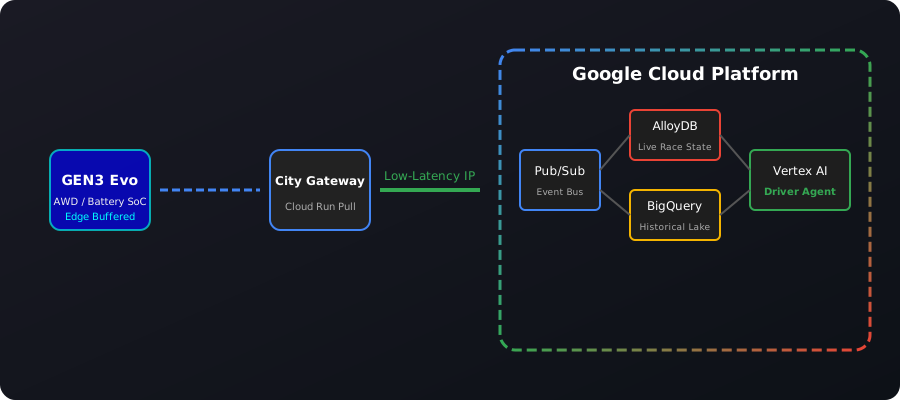
Open the full Formula E Google Cloud telemetry SVG
Why this topology fits Formula E
Formula E has a different systems problem: it races in hostile RF environments where connectivity can degrade abruptly. That shifts the design center from steady-state ingest capacity to replay safety and burst recovery. Pub/Sub absorbs asynchronous catch-up traffic, Dataflow cleans and windows noisy sensor streams, and AlloyDB reduces the architectural tax of moving data between transactional and analytical systems during the race.
The result is an architecture that favors:
- Store-and-forward resilience at the edge.
- Managed event transport for intermittent links.
- HTAP-style querying when strategists and AI agents need immediate answers without waiting for ETL.
Deep technical breakdown: each Formula E Google Cloud component
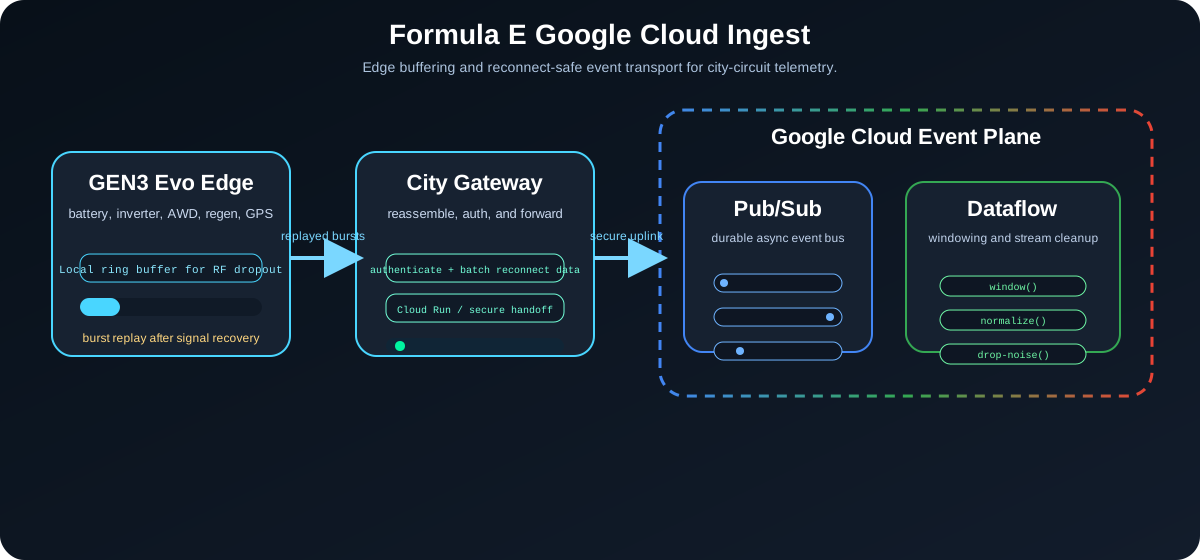
Open the Formula E Google Cloud ingest SVG
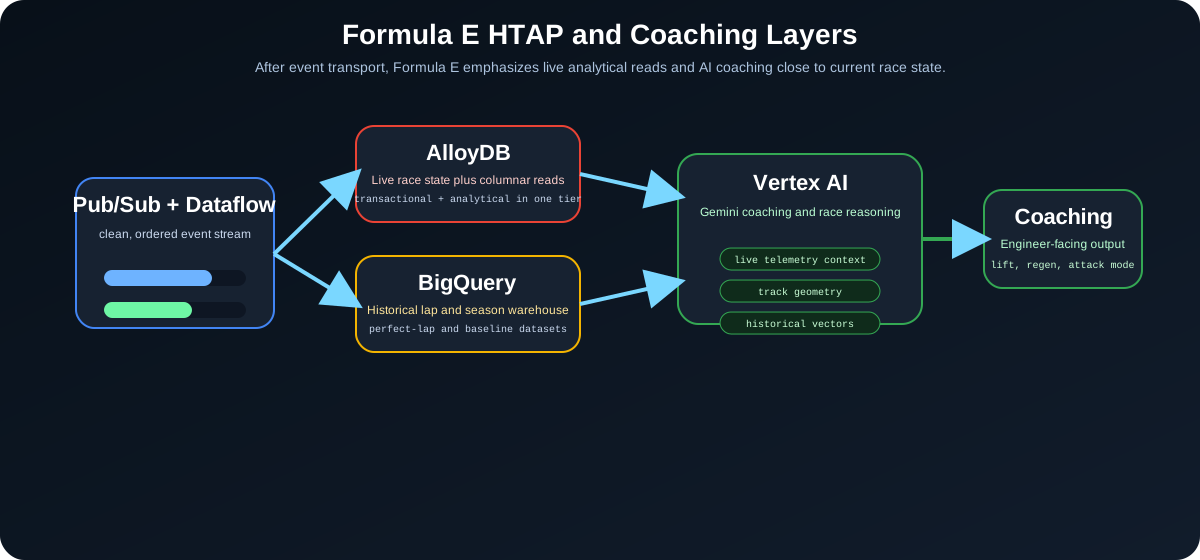
Open the Formula E HTAP and coaching SVG
These two diagrams separate recovery/transport from HTAP/coaching so the inline preview stays readable:
- GEN3 Evo Edge Stack: The local ring buffer on the car temporarily stores telemetry when radio quality drops due to buildings, urban multipath effects, or temporary interference.
- City Gateway: This is the first stable aggregation point after the reconnect. It authenticates the burst upload and re-establishes continuity for cloud ingestion.
- Google Cloud Pub/Sub: Pub/Sub acts as a durable event bus that can safely absorb catch-up bursts without requiring every downstream consumer to be online or equally fast.
- Cloud Dataflow: Built on Apache Beam, Dataflow handles event-time processing, sliding or tumbling windows, watermark logic, normalization, and noise suppression.
- AlloyDB for PostgreSQL: This is the central HTAP idea in the diagram. The same platform can support live transactional race-state updates while also accelerating analytical queries using its columnar engine.
- BigQuery: Long-horizon history, perfect-lap references, and season-level comparison datasets belong here, not in the hot path.
- Vertex AI with Gemini: The AI layer combines live state from AlloyDB, historical baselines from BigQuery, and track/topography context to issue coaching or prediction.
What the animation is meant to communicate in the FE SVG
Again, the motion reflects system semantics:
- The filling ring buffer on the left shows local accumulation before retransmission.
- The moving dots inside Pub/Sub show asynchronous fan-out and delayed catch-up behavior.
- The pulsing AlloyDB and Vertex AI blocks highlight the important FE design choice: analytical and AI reads are placed close to live state rather than after a slow warehouse sync.
The diagram is effectively saying: connectivity is unstable, but the analytical experience must still feel immediate once data lands.
Reading guide for the new FE diagrams
The Formula E visuals are now split the same way:
- Ingest SVG: GEN3 Evo Edge -> City Gateway -> Pub/Sub -> Dataflow.
- Serving SVG: AlloyDB / BigQuery -> Vertex AI -> Coaching output.
This removes the preview cut-off problem on the right side and avoids forcing dense service descriptions into a single frame.
4. The Generative AI Setup: Multi-Modal Insight Generation
While traditional Machine Learning (like XGBoost or Random Forests) has been used for years to predict tire wear and pit windows, Generative AI represents a fundamental shift. In 2026, GenAI bridges the gap between raw, numerical chaos and actionable, human context.
F1 “Track Pulse”: AWS Bedrock
Formula 1 leverages Amazon Bedrock to power the “Track Pulse” application, acting as an automated, multi-modal storyteller for race directors and broadcast producers.
- Multi-Modal Ingestion: Bedrock orchestrates Large Language Models (LLMs) that continuously ingest two completely distinct streams: the live numeric telemetry pipeline (pulled from DynamoDB) and the live audio transcriptions from the driver-to-pit radio communications.
- Contextual Synthesis via RAG: Using Retrieval-Augmented Generation, Bedrock compares live events against 70 years of historical race data stored in S3. If a driver’s telemetry shows a sudden 15% drop in MGU-K deployment, and the audio transcription detects the engineer saying, “Manage temps, switch to default 4,” the model synthesizes this context.
- Actionable Outputs: It automatically generates a natural language prompt pushed directly to the TV director’s screen: “Driver X is suffering critical electrical thermal degradation; expect a 0.5s pace drop per lap.”
FE “Driver Agent”: Google Cloud Vertex AI & Gemini
Formula E takes a more direct, operational approach by leveraging Vertex AI and the multimodal capabilities of Gemini 2.5.
- The Driver Agent: A highly specialized GenAI agent queries AlloyDB for a driver’s live metrics (such as the exact braking point and acceleration curve out of a hairpin) and compares it against historical “perfect lap” vectors stored in BigQuery.
- Real-Time Coaching & Spatial Awareness: Because Gemini handles multi-modal input efficiently, it can correlate 3D track topography data with live State of Charge (SoC) percentages. It processes this data in milliseconds to push actionable text to the race engineer’s dashboard, or even synthesized audio directly to the driver: “Tell Vergne he is over-consuming by 2% in Turn 4; advise lifting 10 meters earlier on the next lap.”
How the GenAI layer actually works
The key point is that GenAI in motorsport is not a magic box. It is a final orchestration layer built on top of existing telemetry engineering. The workflow usually looks like this:
- Acquire live state: pull the current telemetry context from the serving layer, such as DynamoDB or AlloyDB.
- Add secondary modalities: merge radio transcript text, track metadata, weather context, and timing deltas.
- Retrieve historical analogs: fetch prior laps, prior races, or known degradation profiles from long-term storage such as S3 or BigQuery-backed retrieval systems.
- Assemble prompt context: flatten this information into a structured prompt or tool call sequence.
- Run model inference: Bedrock or Vertex AI routes the request to a capable foundation model.
- Apply guardrails: attach confidence scores, domain constraints, or output templates so the result is interpretable and safe for operators.
Detailed GenAI reasoning diagram
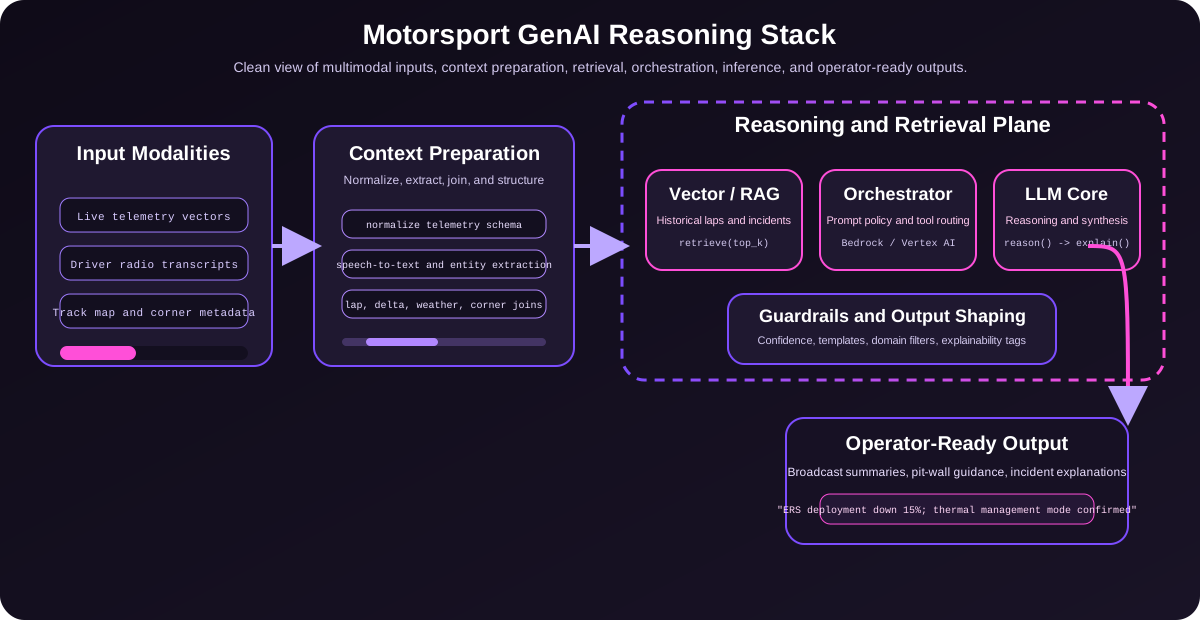
Open the detailed motorsport GenAI stack SVG
This SVG breaks the AI path into concrete technical stages:
- Input Modalities: raw live telemetry, transcribed driver radio, and track geometry or corner metadata.
- Context Preparation Layer: schema normalization, feature flattening, transcript entity extraction, and prompt assembly.
- Vector / RAG Store: a retrieval layer containing historical race fragments, incident summaries, setup priors, or lap archetypes.
- LLM Orchestrator: the service layer that decides which model to call, which tools to attach, and which prompt template or policy to enforce.
- LLM Core: the actual reasoning engine, whether exposed through Amazon Bedrock or Vertex AI.
- Guardrails + Post-processing: confidence scoring, output shaping, domain filtering, and structured handoff to humans.
What the GenAI animation is meant to communicate
The animated bars and glowing inference blocks show a one-way semantic progression:
- from raw machine signals,
- to prepared context,
- to retrieval-backed reasoning,
- to operator-ready language.
That is the core technical story: the model becomes useful only after multiple upstream systems have already transformed telemetry into structured context.
Reading guide for the simplified GenAI diagram
This SVG is intentionally more minimal than the previous revision. The visual priority is the sequence of reasoning stages:
- Input Modalities on the left.
- Context Preparation in the center-left.
- Retrieval, orchestration, and inference inside the highlighted reasoning plane.
- Operator-ready output at the bottom-right.
By removing the explanatory footer and extra callout blocks from inside the SVG, the diagram now emphasizes the actual inference flow instead of competing with it.
5. What These Platforms Teach About Real-Time Systems
The most useful takeaway is not which cloud wins. It is that both architectures converge on the same distributed-systems principles:
- Ingress must degrade gracefully. Whether the bottleneck is packet storms in F1 or intermittent links in FE, telemetry systems fail first at the ingestion boundary.
- Operational state should be cheap to read. Engineers, strategists, and automation layers need fast access to current truth, not expensive joins across cold stores.
- Analytics cannot block control loops. Long-running simulations, reporting, and GenAI synthesis must be isolated from timing-sensitive race operations.
- Historical context multiplies model value. GenAI becomes useful only when joined with prior races, known setup baselines, and expected degradation patterns.
Naming the architectural patterns directly
If you strip away the motorsport branding, the post is really describing a combination of well-known distributed systems patterns:
- Event-driven architecture: producers emit telemetry independently of downstream consumers.
- Queue-based load leveling: SQS and Pub/Sub absorb uneven workloads and protect consumers.
- CQRS-like separation of responsibilities: hot operational state is served differently from historical analytical data.
- HTAP (Hybrid Transactional/Analytical Processing): AlloyDB reduces the split between live writes and analytical reads.
- RAG (Retrieval-Augmented Generation): GenAI outputs are grounded using historical race context instead of relying only on model weights.
- Store-and-forward edge resilience: Formula E specifically relies on local buffering to survive intermittent connectivity.
- Microservice fan-out: Lambda and ECS consumers independently derive specialized products from the same base stream.
For engineers building adjacent systems such as fleet platforms, robotics telemetry, industrial IoT, or connected vehicle backends, the blueprint is clear: start with a resilient streaming core, then layer feature stores, analytical engines, and inference services around it rather than through it.
Conclusion
The 2026 motorsport season proves unequivocally that racing is fundamentally a software engineering discipline. Whether a team is utilizing AWS’s highly decoupled Kinesis/SQS arrays to manage sheer volume, or relying on Google Cloud’s HTAP AlloyDB engine for lightning-fast analytical queries on live streams, the core mission is identical: process millions of data points instantly.
By pushing the very limits of real-time streaming architectures, fault-tolerant edge networking, and multi-modal GenAI inference, Formula 1 and Formula E aren’t just creating better racing. They are aggressively battle-testing the architectural groundwork required for the future of connected autonomous vehicles and smart city infrastructure.
If you strip away the branding, both stacks are really reference architectures for any environment where machines generate more data than humans can interpret in real time. Motorsport simply happens to be one of the few places where the feedback loop is unforgiving enough to expose every weak architectural choice immediately.