Muse Glimmer-30B on the Intel Arc Pro B70
A field note from 2026-08-10. Every number below is a measured single-stream
(C1) result from one campaign on the B70 (results/muse-dflash-sweep-manual-20260810T164735/,
docs/benchmark-history.md Run 33-35). Decode is the llama.cpp engine rate
(timings.predicted_per_second, HTTP); prefill is llama-bench pp. E2
provisional · self-reported, not independently reproduced.
The plot twist first
Muse prefill looked 3-4× slower than the dense-27B baseline (pp4096 ≈ 293 t/s vs
~936). The “optimization” was a build flag, not a kernel:
GGML_SYCL_F16=ON. Without it, the SYCL kernels drop to fp32 paths and prefill
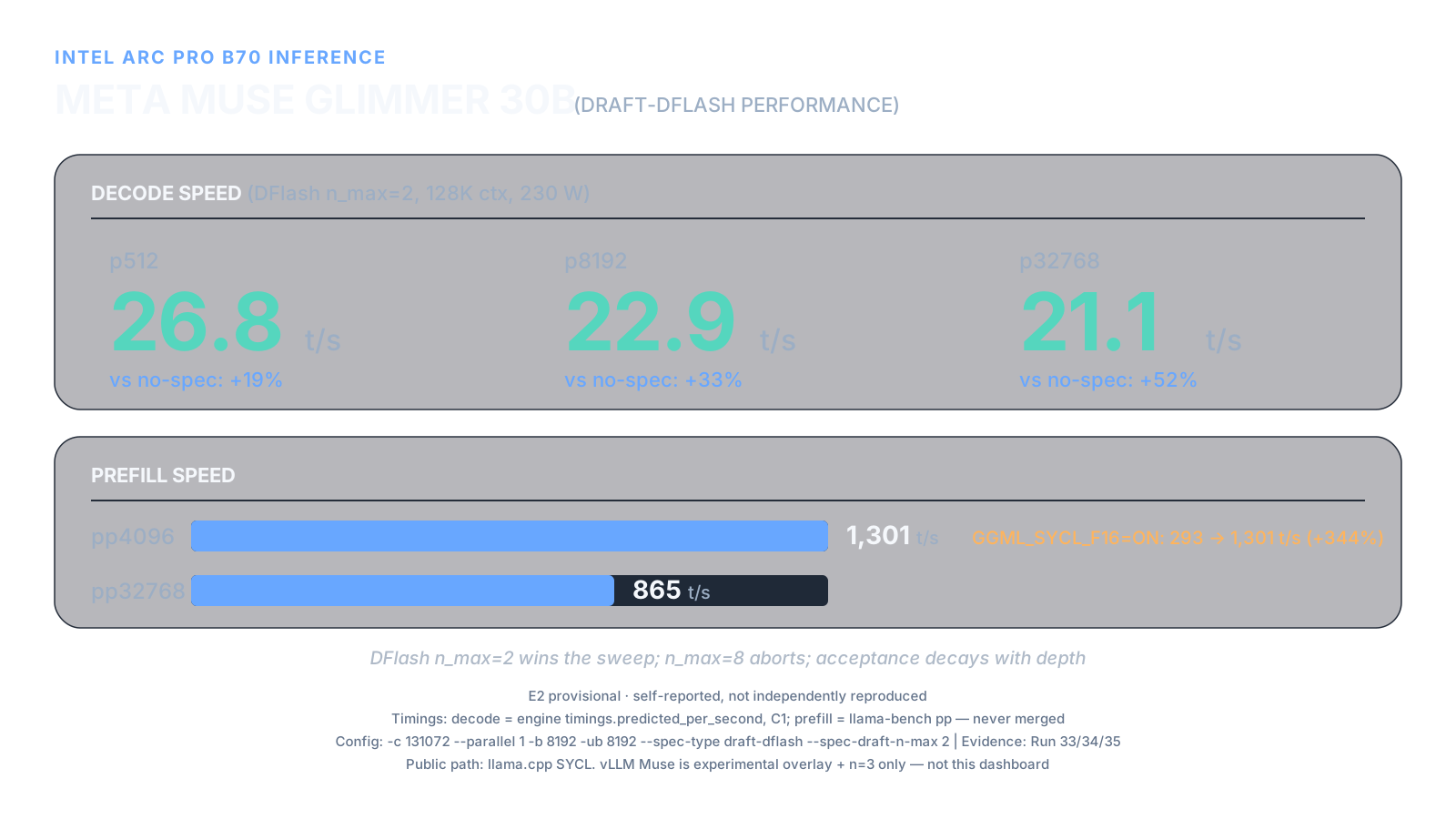
loses 3.4×. With it: pp4096 = 1,301 t/s (+344%), and decode also gains ~16%.
The lesson: verify your cmake flags against the production build before blaming
the architecture.
The model and why it fits
| Text decoder | 27.85B dense, 52 layers, GQA 32/2, sliding-window-2048 (iRoPE) |
| Vision | ViT-G/14 (~1.8B), dynamic resolution |
| Context | 131,072 trained |
| Quirk | Reasoning model — generations carry a reasoning_content channel; short max_tokens returns empty content (use 512+) |
| Spec decode | DFlash block-diffusion draft (block 16, 5 layers) |
VRAM math (32,656 MiB): Q4_K_XL 14.78 GiB + mmproj 1.40 GB + dflash draft
1.63 GB + q8_0/q4_1 KV. 128K ctx fits with --parallel 1 (≈2-4 GiB free);
with 4 slots the KV pool (≈5.6 GiB/slot at 128K) does not. 64K runs with 4 slots.
Results (128K ctx, 230 W cap, -ub 8192, C1 cold, exact unique prompts)
DFlash draft-depth screen (n=3 median, engine decode t/s):
| draft depth | p512/g128 | p8192/g128 | acceptance |
|---|---|---|---|
| no-spec | 22.5 | 17.2 | — |
| n_max=1 | 24.8 | 20.0 | 0.91 |
| n_max=2 | 27.6 | 21.4 | 0.86 |
| n_max=3 | 26.3 | 21.3 | 0.74 |
| n_max=4 | 27.5 | 18.2 | 0.74 |
| n_max=5-7 | 21-23 | 13-15 | 0.30-0.56 |
| n_max=8 | — (server crash at launch) |
Acceptance decays with draft depth (0.91 → 0.30); n_max=8 is unsupported at 128K. Small draft windows win — the same lesson as vLLM spec-N (§15.8).
Winner confirmed (DFlash n_max=2, fresh n=5):
| prompt | t/s median | max | TTFT | acceptance |
|---|---|---|---|---|
| p512/g128 | 26.8 | 28.9 | 1.1 s | 0.85 |
| p8192/g128 | 22.9 | 23.1 | 12.3 s | 0.75 |
| p32768/g128 | 21.1 | 21.1 | 48.1 s | 0.75 (n=3) |
Long-context: DFlash gain grows with context (winner vs no-spec):
| prompt | DFlash n2 | no-spec | Δ |
|---|---|---|---|
| p512 | 26.8 | 22.5 | +19% |
| p8192 | 22.9 | 17.2 | +33% |
| p32768 | 21.1 | 13.9 | +52% |
Prefill (llama-bench pp, no-spec — DFlash does not change prefill): pp512 858 · pp2048 1,278 · pp4096 1,301 · pp8192 1,172 · pp32768 865 t/s. Long-prompt prefill degrades as memory access grows.
Power: 230 W cap; measured draw (energy counter) ~83-138 W during decode windows; peak 73-74 °C.
Config
llama-server -m Muse-Glimmer-30B-UD-Q4_K_XL.gguf \
  --mmproj mmproj-kquant.gguf \
  -c 131072 --parallel 1 -ngl 99 -ncmoe 0 -fa on -ctk q8_0 -ctv q4_1 -t 8 \
  --no-mmap -b 8192 -ub 8192 --host 0.0.0.0 --port 8765 \
  --spec-type draft-dflash --spec-draft-model dflash-kquant.gguf \
  --spec-draft-n-max 2
Vision works via the OpenAI-compatible multipart endpoint (image → correct
description, verified). GGML_SYCL_F16=ON is mandatory in the build.
Methodology and honesty
- Decode = engine
timings.predicted_per_second(C1, cold, unique entropy-first prompts at 512/8192/32768 targets, +~50 chat-template tokens verified per request). Prefill = llama-bench pp. Never merged. - 1 warmup (SYCL JIT, discarded) + n=3 per screen cell; n=5 for the top two
depths. Cap 230 W; draw measured via
energy1_input; temp via hwmon4. - Quality caveat: decode includes reasoning tokens, and speed does not establish output/task-quality parity — a reference-quality check against BF16 is a separate, not-yet-done step.
- 128K loads and serves; the benchmark cells ran to 32K per scope. The 128K full-context cell and a vision-throughput cell remain future work.
Why not vLLM (yet)
Correction — 2026-08-13. The 2026-08-10 note below is still true for FP8. It is no longer true that “no INT4 exists.” A compressed-tensors W4A16 artifact plus a local PR #51655 overlay loaded on XPU. That path is experimental (n=3 text-only screen, not a public image). llama.cpp GGUF + DFlash n2 remains the recommended recipe. Details: cookbook
docs/muse-glimmer/MUSE-GLIMMER-B70.md.
RedHatAI/Muse-Glimmer-30B-FP8-block= 34.4 GB — does not fit 32 GB VRAM.- vLLM XPU has no FP8 linear kernel (
KeyError: PlatformEnum.XPU). - NVFP4/MXFP4 are Blackwell-class; the public llama.cpp path is still GGUF.
- A later compressed-tensors INT4 smoke exists; it is not this post’s measured stack and is not faster than the 26.8 t/s llama.cpp DFlash cell.
References
- Evidence:
results/muse-dflash-sweep-manual-20260810T164735/ - Runs:
docs/benchmark-history.mdRun 33 (first run), Run 34 (flag fix), Run 35 (sweep) - Model:
unsloth/Muse-Glimmer-30B-GGUF· basemeta-models/Muse-Glimmer-30B - Adoption runbook:
.agents/skills/muse-glimmer-adoption/