Situation
After running a dnf update on a fleet of Linux servers, one of the most common questions is: “Does this server actually need a reboot?” While kernel updates obviously require a reboot, sometimes updates to core libraries (like glibc or openssl) mean that running services are using outdated, deleted files in memory.
Instead of guessing or rebooting blindly, we use Tracer.
What is Tracer?
Tracer is a utility that identifies which running applications are using outdated files and need to be restarted, or if the entire system requires a reboot to apply kernel or core library updates.
Task 1 – Installation
In a Red Hat environment (especially when managed by Red Hat Satellite), you can install the katello-host-tools-tracer package.
sudo dnf install katello-host-tools-tracerTip: Add this package to your standard server provisioning Ansible role to ensure it’s present on all new builds.
Task 2 – Using Tracer Locally
Once installed, you can simply run tracer on the command line.
sudo tracerIt will output a list of applications that need to be restarted. For example, it might tell you that sshd and httpd need a restart because openssl was updated.
If the kernel, systemd, or dbus was updated, Tracer will explicitly tell you that a full system reboot is required.
Task 3 – Integration with Satellite
The true power of Tracer shines when integrated with Red Hat Satellite. The katello-host-tools-tracer package automatically reports the server’s state back to the Satellite server.
In the Satellite Web UI, you can now easily filter your host inventory using the search query:
trace_status = reboot_neededThis allows you to quickly generate a list of exactly which servers in your environment need a reboot window, taking the guesswork out of your patching cycles.
Architecture Diagram
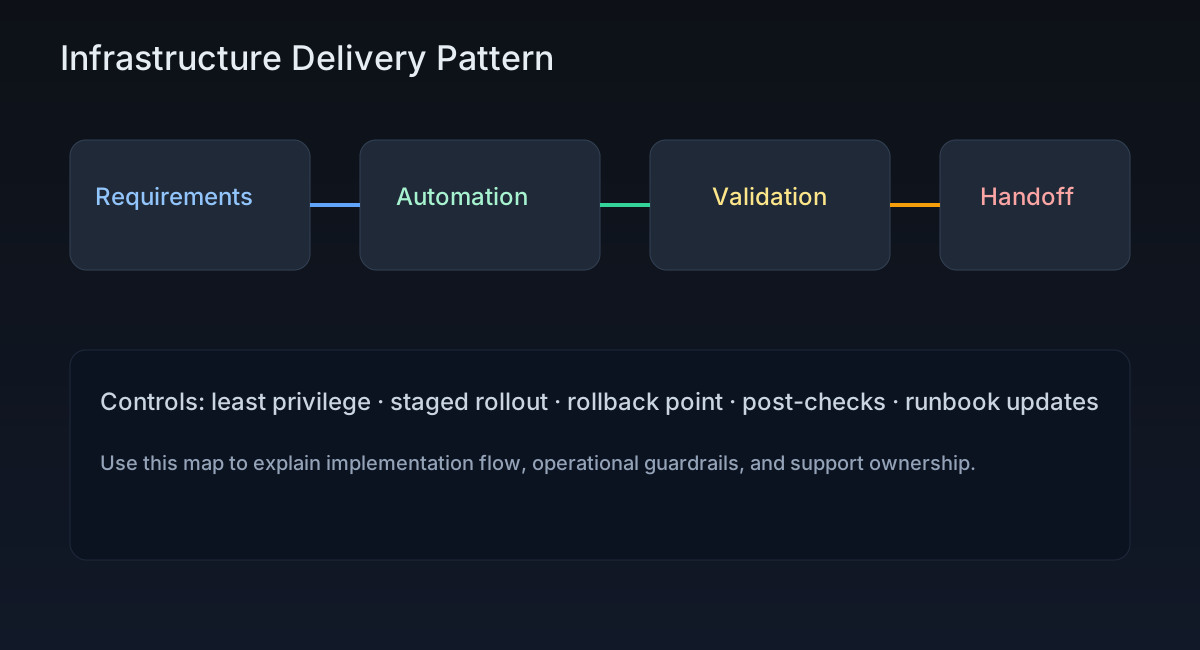
This diagram supports Tracking Required Reboots in RHEL with Tracer and highlights where controls, validation, and ownership boundaries sit in the workflow.
Post-Specific Engineering Lens
For this post, the primary objective is: Harden service integration points and reduce operational surprises.
Implementation decisions for this case
- Chose a staged approach centered on rhel to avoid high-blast-radius rollouts.
- Used patching checkpoints to make regressions observable before full rollout.
- Treated sysadmin documentation as part of delivery, not a post-task artifact.
Practical command path
These are representative execution checkpoints relevant to this post:
systemctl status <service>
ss -tulpn
journalctl -u <service> -n 200 --no-pager
Validation Matrix
| Validation goal | What to baseline | What confirms success |
|---|---|---|
| Functional stability | service availability, package state, SELinux/firewall posture | systemctl --failed stays empty |
| Operational safety | rollback ownership + change window | journalctl -p err -b has no new regressions |
| Production readiness | monitoring visibility and handoff notes | critical endpoint checks pass from at least two network zones |
Failure Modes and Mitigations
| Failure mode | Why it appears in this type of work | Mitigation used in this post pattern |
|---|---|---|
| Auth or trust mismatch | Service looks up but rejects real traffic | Validate identity chain and clock/DNS assumptions |
| Policy-control conflict | SELinux/firewall blocks valid paths | Capture allow-list requirements before rollout |
| Partial restart strategy | Config is applied but not activated safely | Use staged restart with health gates |
Recruiter-Readable Impact Summary
- Scope: deliver Linux platform changes with controlled blast radius.
- Execution quality: guarded by staged checks and explicit rollback triggers.
- Outcome signal: repeatable implementation that can be handed over without hidden steps.